
Reviewed · MAYAN RUINS TOURS
Monte Albán, Arrazola, Cuilapam y San Bartolo Coyotepec.
Oaxaca’s best cultural day trips come in layers. This full-day outing links Zapotec ruins, colonial architecture, alebrijes and black pottery in one practical loop. I especially like the 2.5 hours at Monte Albán, enough time to see the Grand Plaza, ball court, tombs and South Platform, and I like the chance to watch artisans demonstrate traditions still practiced in nearby towns.
The $37.55 price is attractive for an eight-hour trip with transport, a guide, hotel pickup and travel insurance. You should budget extra for Monte Albán and Cuilapam entrance fees, plus lunch. The main drawback is the packed schedule, with plenty of walking and steps, and the English-Spanish commentary may feel uneven for visitors who speak little Spanish.
The tour earns a 4.6 rating from 211 ratings, with 91 percent of people recommending it. Guides such as Gabriel, Antonio, Daniel, Silvia, Jorge, Moisés and Emanuel have been praised for clear explanations and enthusiasm, though one English-speaking customer found too much of the commentary was in Spanish.
In This Review
- Key points at a glance
- Why this four-stop Oaxaca tour works
- Monte Albán: the clear star of the day
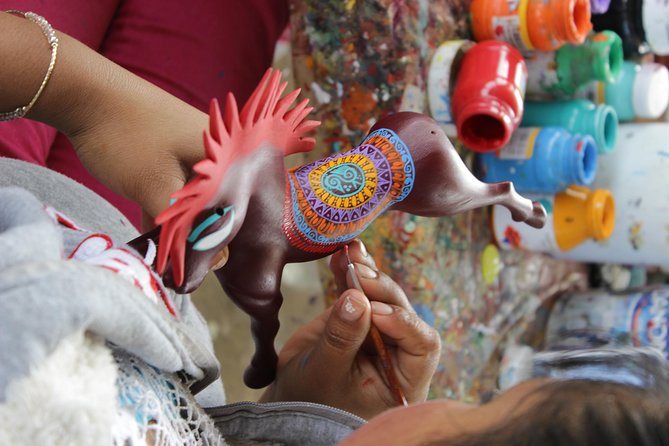
- San Antonio Arrazola and the making of alebrijes
- Cuilapam’s unfinished Dominican convent
- The buffet stop and Oaxaca’s table
- San Bartolo Coyotepec and barro negro
- Guides, language and the group experience
- Price, timing and what you really pay
- Who should book this day trip?
- Should you book it?
- FAQ
- What is included in the Monte Albán and craft towns tour?
- Are Monte Albán and Cuilapam entrance fees included?
- Is lunch included?
- Where does the tour start?
- How much walking is involved?
- Is the tour available in English?
Key points at a glance
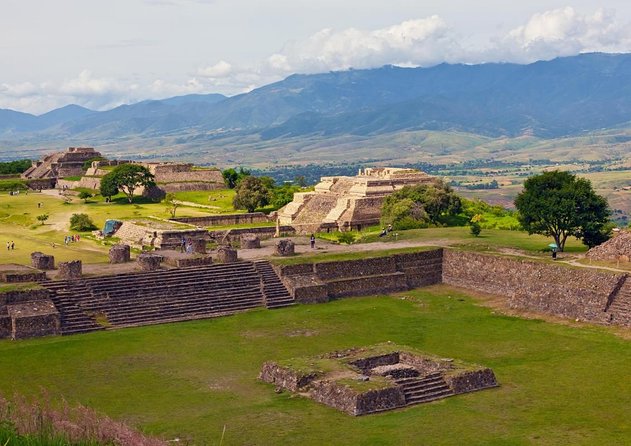
- Monte Albán gets the proper amount of time: About 2.5 hours covers the Grand Plaza, temples, tombs, Los Danzantes, ball court and South Platform.
- You see two living craft traditions: Arrazola is known for copal-wood alebrijes, while San Bartolo Coyotepec is famous for locally made barro negro, or black pottery.
- Cuilapam adds colonial context: The unfinished Dominican convent and its open chapel show how Spanish religious buildings were adapted for large indigenous congregations.
- Lunch is separate but useful: A buffet stop costs about 200 pesos plus drinks, with one recent estimate closer to 300 pesos including a beer.
- The day requires stamina: Monte Albán has uphill walking, broad steps and strong sun, so bring water, a hat, sunscreen and good shoes.
- Small-group transport keeps it manageable: The air-conditioned vehicle carries a maximum of 18 people and returns to the starting point in central Oaxaca.
Why this four-stop Oaxaca tour works
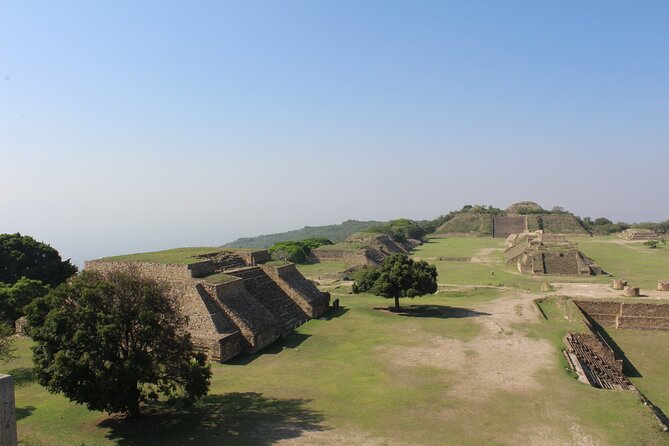
Oaxaca offers enough nearby sights to fill several days, but arranging Monte Albán, Arrazola, Cuilapam and San Bartolo Coyotepec on your own takes time. This tour handles the driving and connects places that tell different parts of the region’s story.
You begin with the Zapotec capital, move into contemporary folk art, then look at Spanish colonial influence before finishing with black pottery. That sequence gives the day a useful rhythm. It is not only an archaeological outing, and it is not only a shopping trip.
I like that the tour combines major sights with working craft towns. The workshops are commercial places, so you will have the chance to buy something, but the demonstrations help explain why the objects cost what they do. Several visitors found the craft presentations especially worthwhile, including demonstrations of alebrije carving and black pottery production.
The group size is limited to 18 people. That is not private touring, but it is small enough for questions and easier movement than a large coach group. Pickup begins at 8:30 a.m. from Quinta Real, at 5 de Mayo 300 in Oaxaca’s Centro, and the activity ends back at the meeting point in the evening.
More Mayan Ruins Tours in Oaxaca
- Monte Alban Guided Half Day Tour
★ 5.0 · 880 reviews - Oaxaca de Juarez: Monte Alban Half-Day Tour
★ 4.7 · 492 reviews - Half day tour to Monte Albán
★ 4.5 · 420 reviews
Monte Albán: the clear star of the day
Monte Albán sits on a mountaintop above Oaxaca, with wide views across the city and the Oaxaca Valley. The setting alone makes the visit memorable, but the scale of the ancient Zapotec city is what gives the stop its weight.
Allow about 2.5 hours here. Your guide leads you through the Grand Plaza, a broad ceremonial area surrounded by platforms, temples and pyramids. You will also see altars, the I-shaped ball court built around 100 BC, and the South Platform with its wide staircase and high views.
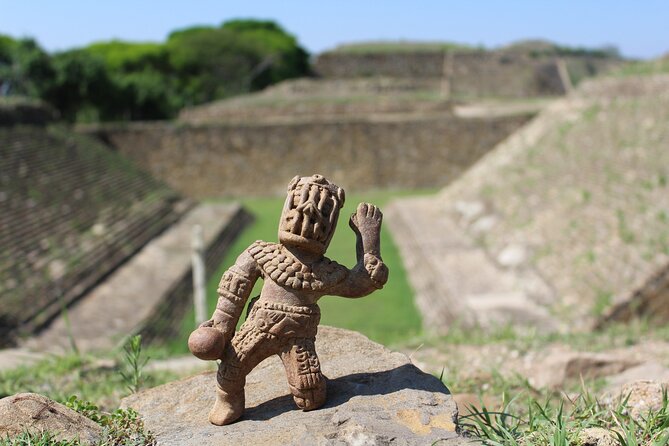
The stone carvings called Los Danzantes are another important stop. Their figures have prompted long study and debate, and a good guide can make them more than a quick photo stop. Guides with archaeological training, including Antonio, Daniel and Silvia, have been praised for explaining the site in detail. Emanuel was also praised for connecting individual places to wider Zapotec history and culture.
Monte Albán contains about 170 tombs. You will not explore every one, but the guide explains how excavations revealed paintings and stone carvings that add detail to what is otherwise a very monumental site. The tour is strongest when the guide connects the temples and plazas to the people who used them.
Plan for uphill walking and steps. One person described the climb as a real workout, and that is useful advice. The site is exposed, with little relief from the sun in the information provided, so take water, sunscreen and a hat. An umbrella can also help block the sun. Wear shoes with a secure sole.
The admission ticket is not included. The exact fee can change, so check current pricing before you go. One recent estimate put Monte Albán and the convent entrances together at about 175 pesos per person, but treat that as a guide rather than a fixed price.
San Antonio Arrazola and the making of alebrijes
After Monte Albán, the vehicle heads to San Antonio Arrazola, a quiet town at the mountain’s base. You spend about 45 minutes here, usually visiting an artisan workshop and seeing the woodcarving process.
Alebrijes are fantastical figures made from copal wood. They may look like animals, monsters or creatures from a dream, often with elaborate forms and bright painted details. The appeal is not just the finished object. You get a look at a craft passed through generations, from carved wood to painted sculpture.
The workshop visit also helps you judge quality. You can see the care behind the carving and painting, then browse the family’s work at its own pace. Several people found the demonstrations intuitive and enjoyed having enough time to shop without feeling rushed or pressured.
Forty-five minutes is enough for an introduction, but not enough for a long, leisurely visit through multiple workshops. If alebrijes are a major reason you are coming to Oaxaca, plan a separate visit to Arrazola on another day. On this tour, the stop works best as a focused look at the craft rather than a full village exploration.
Cuilapam’s unfinished Dominican convent
Cuilapam de Guerrero brings a different period into the day. The 16th-century Dominican convent is known for its unfinished basilica and open chapel, or capilla abierta.
The open chapel is especially interesting because it was designed to address large indigenous congregations during the conversion of local communities to Catholicism. Instead of gathering everyone inside a conventional church, religious services could take place in an open setting.
This stop provides an important counterpoint to Monte Albán. At the ruins, you are looking at Zapotec ceremonial and civic life. At Cuilapam, you are seeing the physical and religious changes brought by Spanish colonial rule.
The convent visit lasts about an hour. The main site ticket is not included, and the museum costs an additional 70 pesos per person if you choose to enter. You should ask the guide what the ticket covers on the day, especially if you are trying to keep extra costs low.
I find the convent valuable for travelers interested in colonial and missionary history, but it will not have the same pull for everyone. A few people felt this stop lasted too long, especially after the morning at Monte Albán. If your priority is archaeology and crafts, the convent may feel like the least essential part of the route.
Same base, a different sort of day:
- Hierve el Agua, Tule Tree, Mitla and Mezcal Distillery Tour
★ 4.5 · 1,094 reviews - Explore Hierve el Agua, Mitla, Tule, Textile and Mezcal for a day
★ 5.0 · 1,043 reviews - From Oaxaca de Juarez: Hierve el Agua and Mezcal Distillery
★ 4.9 · 615 reviews - AUTHENTIC OAXACA CULTURAL FOOD TOUR, eat like a local.
★ 5.0 · 462 reviews
The buffet stop and Oaxaca’s table
Lunch is taken near the Cuilapam area at a buffet restaurant. It is not included, and the stated cost is about 200 pesos plus drinks. One recent account put the total at roughly 300 pesos per person for the buffet and one beer.
The timing can be late. One person ate around 2 p.m., so a large breakfast is not a bad idea. The positive side is that the buffet gives you time to sit down after Monte Albán and the morning visits. It also offers a chance to try several Oaxacan dishes rather than committing to one plate.
The food received some of the strongest praise of the day. Mole, in particular, was singled out as better than versions served at expensive restaurants in Oaxaca City. Other comments describe the buffet as a welcome and satisfying part of the experience.
I would treat lunch as a pleasant bonus, not the main reason to book. The restaurant setting and menu can change, and drinks cost extra. If you have dietary restrictions, ask the guide what is available before filling your plate.
San Bartolo Coyotepec and barro negro
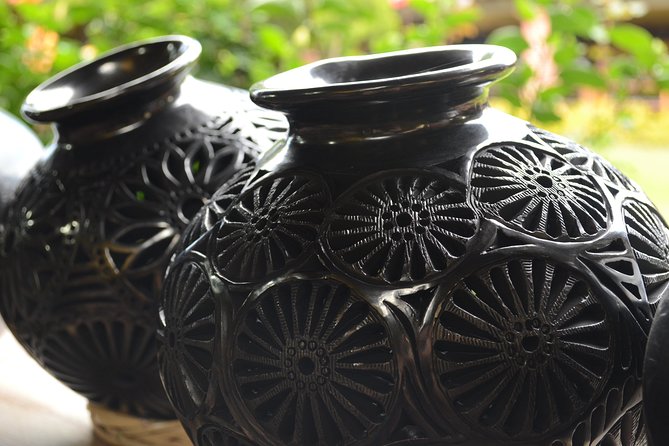
The final craft stop is San Bartolo Coyotepec, a town known for black pottery made from local clay. This ceramic tradition dates to pre-Columbian times and remains one of Oaxaca’s best-known art forms.
You spend about 45 minutes visiting the San Bartolo Coyotepec Church, the Oaxaca State Museum of Popular Art, and a craft market featuring work from more than a dozen families. The route information also describes a pottery workshop and demonstration, which many people found fascinating.
Barro negro is more than a dark finish. The demonstration shows the careful work behind the shape, surface and final appearance of each piece. The stop makes it easier to understand why a small sculpture or vessel can represent many hours of skilled labor.
The craft market is a good place to buy directly from local makers. Some people were more interested in the pottery demonstration than the church, while others appreciated the church’s colonial setting. The visit is not designed as a long museum tour, so you will get an introduction rather than a full study of Oaxacan ceramics.
Like Arrazola, this stop includes a shopping opportunity. The accounts provided do not describe aggressive sales tactics, and several people specifically noted that they had time to browse without pressure. Still, you should feel free to look, ask questions and buy only if something truly appeals to you.
Guides, language and the group experience
The guide can make or break a history-heavy day. The strongest accounts praise guides who explain archaeology, art, botany and colonial history in a clear, lively way.
Antonio was praised for extensive archaeological knowledge and clear English. Daniel received similar praise for covering history, archaeology, botany and art. Silvia was described as excellent while explaining every stage from Monte Albán through the craft towns. Gabriel was praised for warmth, strong historical detail and fluent English and Spanish. Moisés and Emanuel were also singled out for friendliness and enthusiasm.
The tour is offered in English and Spanish. That does not always mean every explanation will be delivered equally in both languages. One person who spoke little Spanish felt the commentary leaned too heavily toward Spanish, making some archaeological explanations hard to follow.
If clear English instruction is essential to you, confirm the language arrangement before booking or ask at pickup how the day will be handled. The guide may be excellent, but a bilingual group can require some patience as explanations are repeated.
A guide may also offer personal opinions or speak at length. One account praised the guide overall but felt he sometimes went into long personal discussions. That is a minor issue, but it matters on a long day when every stop has a schedule.
Price, timing and what you really pay
At $37.55 per person, this is a strong value if you want transportation and several stops in one day. The air-conditioned vehicle, professional guide, hotel pickup and travel insurance are included.
The advertised price is not the complete cost. Set aside money for:
- Monte Albán admission
- Cuilapam admission
- The optional Cuilapam museum, listed at 70 pesos
- Buffet lunch, about 200 pesos plus drinks
- Tips and personal purchases
The tour begins at 8:30 a.m. and lasts about eight hours, though some days run longer. One account reported returning shortly after 5 p.m., while another said the schedule ran so late that dinner plans had to be canceled.
That timing is important. Do not book a tight evening reservation, airport transfer or performance immediately after the tour. Pickup is normally from central Oaxaca, and the listed end point is the original meeting point. If you need a different hotel drop-off, confirm it with the guide during the day.
The service has free cancellation up to 24 hours before the start time. Cancellations inside that window are not refunded, and changes are not accepted.
Who should book this day trip?
I would choose this tour if you want a broad introduction to the Oaxaca Valley without arranging several separate taxis or guides. It suits first-time visitors, families with older children, solo visitors and couples who enjoy history, art and local crafts.
It is also a good fit if you want a guide at Monte Albán. The ruins are impressive on their own, but the Zapotec context, Los Danzantes, tombs and ball court make more sense with explanation.
I would think twice if you want a slow day. Four major stops plus lunch create a full schedule. Monte Albán involves heat, stairs and uphill walking, and the final return may be later than planned.
You may also prefer a Monte Albán-only tour if the ancient site is your main goal. Some people found the convent and craft stops less compelling than the archaeological complex. On the other hand, if you want to understand Oaxaca through both its ancient monuments and its working arts, the variety is exactly the point.
Should you book it?
Book this tour if you want value, variety and a full day outside Oaxaca City. Monte Albán is the essential stop, and the alebrije and black pottery demonstrations add real cultural interest rather than simply filling time.
Go prepared for extra entrance fees, a late buffet lunch, sun, stairs and possible bilingual commentary. Bring water, sunscreen, a hat and good walking shoes. If those conditions suit you, this is an efficient and well-priced way to connect four important places around Oaxaca.
FAQ
What is included in the Monte Albán and craft towns tour?
The tour includes an English- and Spanish-speaking professional guide, travel insurance and transportation in an air-conditioned vehicle. Hotel pickup and return to the starting point are also included.
Are Monte Albán and Cuilapam entrance fees included?
No. Admission tickets for Monte Albán and Cuilapam are not included. The optional Cuilapam museum is listed at an additional 70 pesos per person.
Is lunch included?
No. Lunch is purchased separately at a buffet restaurant near Cuilapam. The stated cost is about 200 pesos plus drinks.
Where does the tour start?
The listed meeting point is Quinta Real, 5 de Mayo 300, in Oaxaca City’s Centro. The start time is 8:30 a.m., and the activity ends back at the meeting point.
How much walking is involved?
You need a moderate level of physical fitness. Monte Albán includes uphill walking, steps and a climb to viewpoints, so comfortable shoes, water, sunscreen and a hat are recommended.
Is the tour available in English?
Yes. The experience is offered in English and includes an English- and Spanish-speaking guide. Since the day is bilingual, English commentary may not always receive equal time, so confirm the language arrangement if this is important to you.
Newly listed around Oaxaca
- Oaxaca Walking Tour★ 5.0 · 32 reviews
- Private Minivan: Huatulco International Airport (HUX)★ 4.0 · 119 reviews
- Traditional Oaxaqueña Cooking with Grandma’s Recipes★ 5.0 · 260 reviews
- Culture, History and Food in Oaxaca City★ 5.0 · 43 reviews
- Ultimate Hierve el Agua Hike + Textile Art★ 5.0 · 42 reviews
- Private and safe transfer from the airport to the hotel in Oaxaca★ 4.5 · 58 reviews
- Private and Secure Transfer Hotel to Oaxaca Airport★ 5.0 · 33 reviews
- Tour Boil the “classic” water★ 4.5 · 67 reviews
Mayan Ruins Tours, compared.
Teotihuacan, Guadalupe Shrine & Tlatelolco Day Tour with Lunch
Read our review →
Teotihuacan pyramids morning or afternoon without tourist traps
Read our review →
Teotihuacan Early Access Guided Tour with optional Lunch
Read our review →
Teotihuacan, Tlatelolco & Guadalupe Shrine Tour
Read our review →
Teotihuacan Hot Air Balloon Flight from Mexico City / Volare
Read our review →
Balloon flight + pick up in CDMX + Breakfast in Cave + Teotihuacan
Read our review →
Browse the lists this tour appears in