
Reviewed · MEXICO CITY TOURS
Palace of Fine Arts Mural Tour
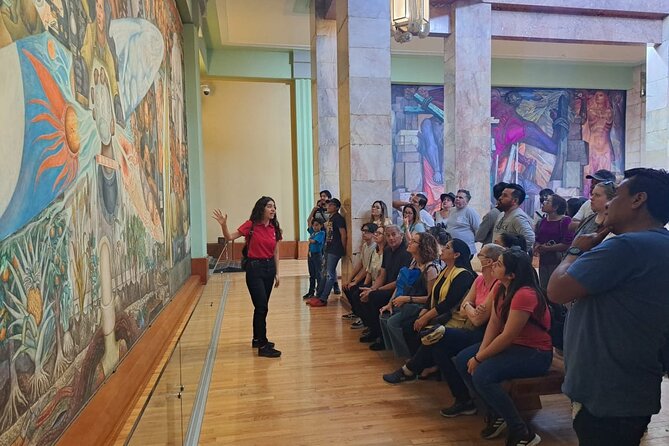
Murals speak here. This Palace of Fine Arts tour makes Mexico City’s mural movement easier to read, linking each painting to politics, identity, and the artists who made it. I like the focus on both the building and its art, and I like that guides such as León explain symbolism in clear English rather than simply pointing at famous names.
The main consideration is the admission wording. The details say entries are included, but also say the admission ticket is not included. Confirm this before paying, since it affects the real cost. The tour also lasts only about 1 to 1.5 hours, so you get a focused introduction rather than a full museum visit.
In This Review
- Key Points Before You Book
- Why the Palace of Fine Arts Is the Right Place to Start
- Reading Diego Rivera’s Man at the Crossroads
- From Revolution to Liberation
- Orozco’s Katharsis: A More Troubling View
- Rivera’s Carnival of Huejotzingo
- Siqueiros and the Drama of History
- Tamayo, Rodríguez Lozano, and a Change of Tone
- What the Guide Adds to the Visit
- Is $56.75 a Fair Price?
- Timing, Group Size, and Practical Expectations
- Who Will Get the Most From This Tour?
- Should You Book the Palace of Fine Arts Mural Tour?
- FAQ
- Where does the Palace of Fine Arts Mural Tour begin?
- Where does the tour end?
- How long does the tour last?
- Is the tour offered in English?
- What is included in the tour?
- How many people can join the tour?
- Can I cancel for a full refund?
Key Points Before You Book
- Seventeen murals are part of the discussion: The tour covers major works by Diego Rivera, David Alfaro Siqueiros, José Clemente Orozco, Jorge González Camarena, Rufino Tamayo, and others.
- The Rockefeller Center story adds drama: You hear how Rivera painted a mural in New York that was later destroyed because of its political message.
- Architecture comes before the symbolism: The guide explains the interior and exterior of Palacio de Bellas Artes, giving the paintings a proper setting.
- English guidance is available: León has been praised for clear English, patience, and detailed explanations of each mural.
- The group can reach 35 people: That is manageable for a guided visit, though a larger group may make it harder to hear or get a close look.
- The price is $56.75 per person: Its value depends largely on whether admission is included, a point you should verify before booking.
Why the Palace of Fine Arts Is the Right Place to Start
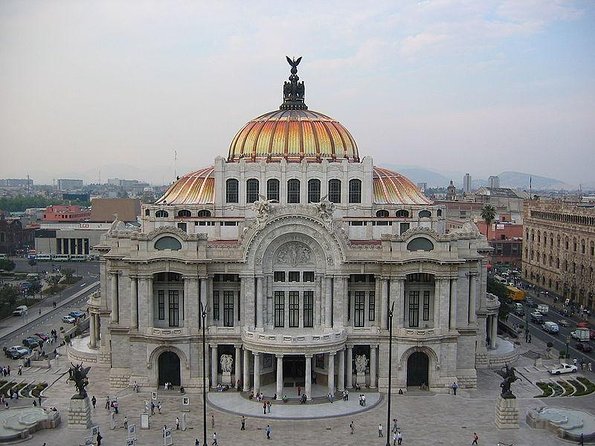
Palacio de Bellas Artes is more than a grand theater with a famous white exterior. It is one of the defining buildings in Mexico City’s historic center, and UNESCO declared it a World Heritage Site in 1987 as part of the area’s cultural importance.
The building itself gives the tour a strong opening. You learn about the project associated with Porfirio Díaz and the way its purpose and design fit Mexico’s changing national identity. The guide covers both the outside and inside, so you are not left treating the murals as separate pictures on a wall.
That setting matters. Mexican muralism was not created as private art for a small room. These works were meant to be seen in public places, where ideas about workers, revolution, Indigenous identity, education, religion, and political power could reach a broad audience.
I like that the tour begins with the building before turning to individual murals. Without that context, it is easy to admire the colors and miss the argument. With a guide, you have a better chance of seeing why a figure appears in a particular pose, why a symbol repeats, or why an artist’s politics changed the meaning of a scene.
A few more Mexico City runs worth comparing
- Teotihuacan, Guadalupe Shrine & Tlatelolco Day Tour with Lunch
★ 5.0 · 11,603 reviews - Xochimilco, Coyoacan and Frida Kahlo with Optional Lunch
★ 4.5 · 7,320 reviews - Balloon flight + Breakfast in cave + Pyramids + Pick up CDMX.
★ 5.0 · 6,335 reviews
Reading Diego Rivera’s Man at the Crossroads
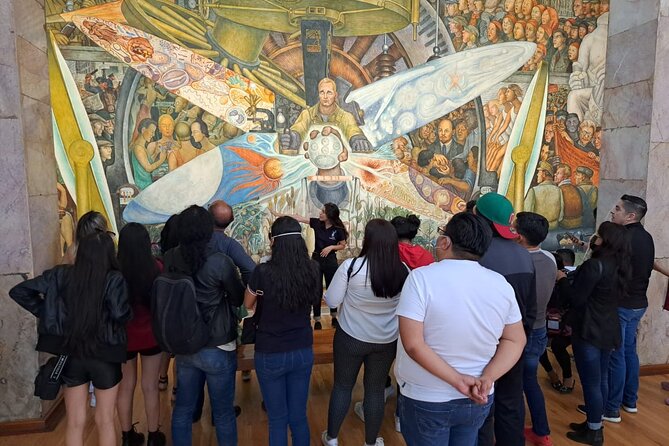
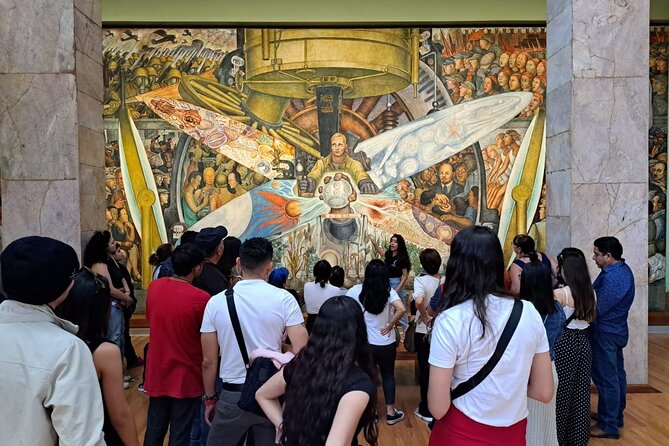
One of the most important stops is Diego Rivera’s Man, Controller of the Universe, also called Man at the Crossroads. The work is tied to the mural Rivera painted for Rockefeller Center in New York.
That original mural became controversial because Rivera included an image of Vladimir Lenin. The Rockefeller family objected to the political content, and the mural was destroyed. The version at the Palace of Fine Arts preserves Rivera’s larger idea and allows the guide to explain why the work caused such a fierce argument.
This is the kind of story that makes a guided visit worthwhile. You are not just looking at a large scene packed with people, machines, and symbols. You are considering who gets to control public art, how political beliefs enter a commission, and why a mural can be treated as a public threat.
Give this stop time. The composition has a lot going on, and a quick glance will not reveal its structure. A good guide can help you move from the central human figure to the surrounding social and scientific references without turning the explanation into a list of names.
From Revolution to Liberation
The tour also includes Liberation by Jorge González Camarena. Its title points toward one of the recurring themes in Mexican muralism: freedom as both a national idea and a personal struggle.
Camarena’s work gives the tour a chance to move beyond Rivera and the most familiar names. That is useful because Mexican muralism was not the work of one artist or one style. Each painter handled national themes in a different way, and the guide helps you notice those differences.
The exact impact of this stop depends on the explanation you receive. The title alone does not tell you how the figures, gestures, and colors fit together. That is where the guide’s preparation matters. The strongest praise for this experience centers on detailed explanations, symbolism, and cultural context, rather than on a quick survey of the room.
Orozco’s Katharsis: A More Troubling View
José Clemente Orozco’s Katharsis brings a darker mood. Orozco often approached modern society with less optimism than Rivera, and this mural gives the tour a place to discuss violence, machinery, mass culture, and human behavior.
The name Katharsis suggests cleansing through an intense emotional release, but the work is not a gentle scene. You may find its images unsettling or crowded, and that is part of its force. The guide can help you separate its visual shock from its larger criticism.
This is an important balance in the tour. Mexican muralism is sometimes reduced to cheerful public art about national pride. Orozco complicates that picture. His work asks you to look at the cost of political and social change, not just its slogans.
If you prefer art that explains itself quickly, this may be one of the harder stops. If you like paintings that raise uncomfortable questions, it may be one of the most rewarding.
Same base, a different sort of day:
- Teotihuacan pyramids morning or afternoon without tourist traps
★ 5.0 · 6,186 reviews - Teotihuacan Early Access Guided Tour with optional Lunch
★ 4.5 · 6,138 reviews - Balloon flight + pick up in CDMX + Breakfast in Cave + Pyramids
★ 5.0 · 5,651 reviews - Balloon Flight + Cave Breakfast + Pick Up from CDMX or We Fly
★ 5.0 · 4,410 reviews
Rivera’s Carnival of Huejotzingo
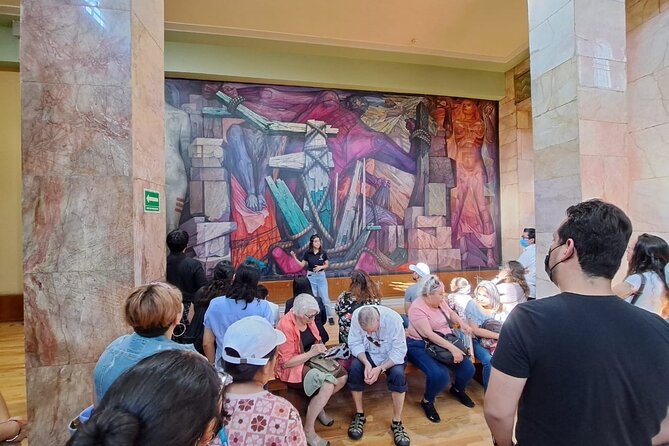
The Carnival of Huejotzingo returns you to Rivera, but it offers a different kind of subject. Instead of focusing only on political theory or industrial society, it draws from Mexican popular culture and local tradition.
The title refers to the carnival of Huejotzingo, giving the guide an opening to explain how celebrations, costumes, performance, and regional identity enter mural art. This is a useful reminder that Rivera’s work was not limited to portraits of revolutionaries or scenes of labor.
Look for the way a public festival can carry several layers at once. A carnival may be entertainment, but it can also preserve memory, show social roles, and connect modern Mexico with older customs. You will get more from the mural if you let the guide explain those connections instead of treating it as a decorative scene.
Siqueiros and the Drama of History
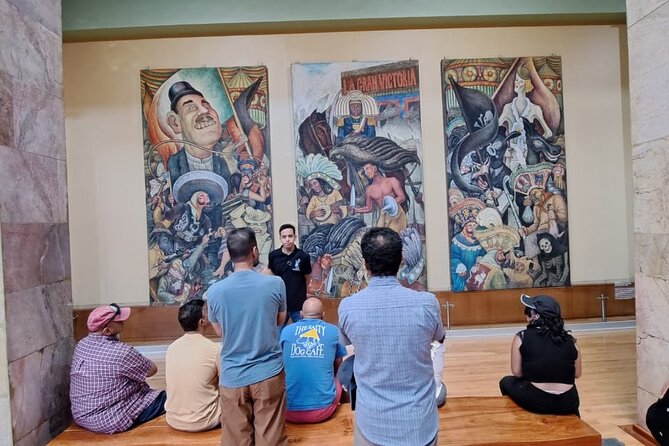
David Alfaro Siqueiros is represented by the Diptych Torment and Apotheosis of Cuauhtémoc and the Triptych of the New Democracy. These works bring Indigenous history and modern political ideals into the same conversation.
Cuauhtémoc, the last Mexica ruler of Tenochtitlan, is a powerful figure in Mexican national memory. A title pairing torment with apotheosis suggests suffering followed by transformation or symbolic elevation. The guide’s explanation helps you understand how Siqueiros uses that historical figure to speak about conquest, resistance, and the meaning of national heroes.
The Triptych of the New Democracy shifts the focus toward political change. A triptych is made of three related panels, so the arrangement itself matters. Ask the guide how the three sections work together and how the central image relates to the side panels.
Siqueiros can be challenging because his work often feels forceful and crowded. His figures and motion do not always offer a calm place for your eye to rest. That is why this portion benefits from a guide who can give you a path through the composition.
The experience is not simply a parade of famous painters. It places Rivera’s political conflict, Orozco’s unease, and Siqueiros’s historical drama side by side. That comparison is one of the tour’s best features.
Tamayo, Rodríguez Lozano, and a Change of Tone
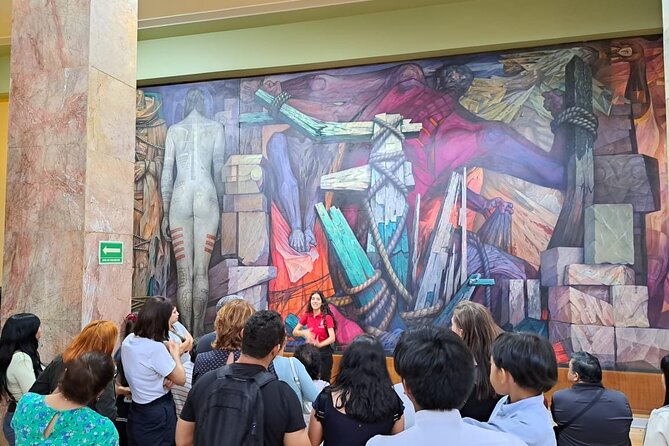
The route also includes Rufino Tamayo and La Piedad by Rodríguez Lozano. These names widen the discussion beyond the three painters most often associated with Mexican muralism.
Rufino Tamayo is especially useful in showing that Mexican art did not move along one straight path. His work can be discussed alongside the mural tradition while also revealing a different approach to color, form, and subject matter.
The mention of La Piedad by Rodríguez Lozano adds another point of comparison. The title invokes a familiar religious theme, but its place in this group of works gives the guide a chance to discuss how Mexican artists handled European religious imagery within a local cultural setting.
This part of the tour may pass quickly because the full program includes many works in a short period. If one of these painters interests you most, ask the guide for the artist’s name again and make a note for later study. The tour is best used as a well-organized introduction, not as the last word on every artist.
What the Guide Adds to the Visit
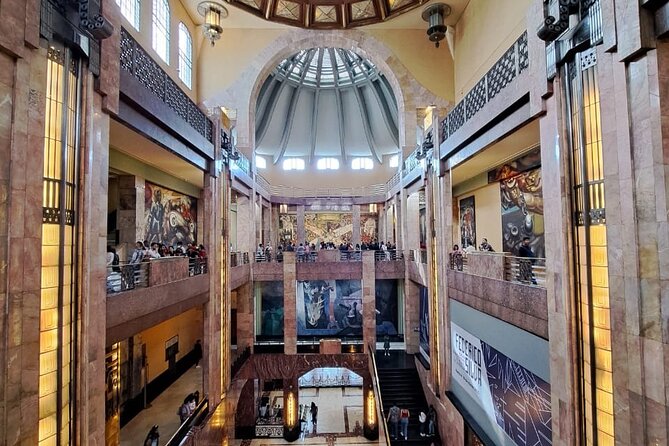
The most praised part of this experience is the guiding. Diego is described as telling the mural stories with detail and excitement, while León is praised for explaining symbolism, history, and cultural context in English.
León is also described as being well prepared and friendly, even while leading the tour for the first time. That detail matters because enthusiasm is useful only when it is matched by clear delivery. The strongest guide experience here appears to come from a willingness to explain each work instead of rushing from name to name.
You should expect interpretation rather than a silent walk through the palace. The guide explains the architecture, then places the murals within Mexican history and the lives of their artists. That makes the visit more useful for someone who has seen the images online but never understood what they mean.
A maximum group size of 35 is listed. That is not an intimate private tour, and you may need to position yourself carefully in front of a mural. Still, a certified English-speaking guide can make a large public space easier to follow than exploring alone.
Is $56.75 a Fair Price?
At $56.75 per person, this is not a bargain-priced museum orientation. The value rests on the guide’s interpretation, the number of major murals covered, and the time you save by receiving a structured explanation.
I think the price can make sense if you are especially interested in Mexican art, political history, or the connection between public buildings and national identity. You are paying for a focused lesson, not just entry into a building.
The admission details need attention. One section says entries are included, while another says the admission ticket is not included. Because those statements conflict, contact the provider before booking and ask exactly what the $56.75 covers. If admission is extra, add that amount to your budget before deciding.
The average booking time is six days ahead. That suggests planning several days in advance, especially if your Mexico City schedule is tight. You receive a mobile ticket, and the meeting point is at Palacio de Bellas Artes on Avenida Juárez in the historic center.
The tour ends where it begins, which is convenient if you want to continue exploring the area afterward. Public transportation is nearby, and the activity is listed as suitable for most people. Service animals are allowed.
Timing, Group Size, and Practical Expectations
The stated duration is about one hour to one hour and 30 minutes, with the detailed timing given as 1.5 hours. Plan around the longer estimate so you are not rushing to your next activity.
That length is enough for a focused explanation of the main murals, but not enough for every detail in the palace. You will need to accept a brisk pace, especially with 17 murals and several artists included in the discussion.
Wear something comfortable for a standing tour, though the supplied information does not specify how much seating is available. Arrive at the exact meeting point, Palacio de Bellas Artes, and keep your mobile ticket ready.
Food and drink are not included. Since the tour is short and ends at the starting point, you can easily plan a meal before or after, but you should not expect refreshments as part of the activity.
Free cancellation is available if you cancel at least 24 hours before the start time. Cancellations made within 24 hours are not refunded, and changes during that period are not accepted. The cut-off follows Mexico City local time.
Who Will Get the Most From This Tour?
I would choose this for you if you want a clear introduction to Mexican muralism without committing to a long art course. It suits first-time visitors to the Palace of Fine Arts, people curious about Rivera’s Rockefeller Center controversy, and anyone who wants help reading political symbols.
It is also a good fit if English is your preferred language. The guide is certified, and León has been specifically praised for explaining complex subjects clearly in English.
You may find it less suitable if you want a slow, private look at every painting or a broad tour of all the palace’s cultural spaces. The group can reach 35 people, and the time limit means the visit has to keep moving.
The experience is strongest for people who ask questions. Ask why Rivera’s mural was destroyed, how Siqueiros presents Cuauhtémoc, and what separates Orozco’s tone from Rivera’s. Those questions turn a short visit into a more personal lesson.
Should You Book the Palace of Fine Arts Mural Tour?
I would book it if the admission cost is confirmed and you want substance rather than a quick photo stop. The guide-led format, English explanations, and attention to symbolism give the murals a clearer voice.
The best reasons to go are the mix of architecture and art, the Rockefeller Center story, and the reported care shown by guides such as León and Diego. The main reasons to pause are the price, the possible extra admission fee, and the limited time for such a large group of works.
If you already know Mexican muralism well, you may prefer to explore independently and spend longer with a few favorite paintings. If you are new to the subject, this compact tour should give you the names, themes, and questions you need to look at the palace with sharper eyes.
FAQ
Where does the Palace of Fine Arts Mural Tour begin?
The tour begins at Palacio de Bellas Artes, Av. Juárez S/N, Centro Histórico de la Ciudad de México, Centro, Cuauhtémoc, 06050 Ciudad de México, CDMX, Mexico.
Where does the tour end?
The activity ends back at the meeting point at Palacio de Bellas Artes.
How long does the tour last?
The tour lasts approximately one to 1.5 hours. The detailed duration is listed as 1.5 hours.
Is the tour offered in English?
Yes. English is one of the listed language options, and the tour is offered with an English-speaking guide.
What is included in the tour?
A certified guide and entries are listed as included. However, another part of the information says admission is not included, so confirm this point with the provider before booking.
How many people can join the tour?
The maximum group size is 35 people.
Can I cancel for a full refund?
Yes, if you cancel at least 24 hours before the experience start time. Cancellations made less than 24 hours before the start time are not refunded.
Newly listed around Mexico City
- Ticket to Frida Kahlo Museum on CDMX★ 4.5 · 44 reviews
- Epic Centro Histórico Walking Tour★ 5.0 · 77 reviews
- Eat Like A Local By The Taco Mensch★ 5.0 · 55 reviews
- Eat and Explore Local Markets in Mexico City★ 5.0 · 83 reviews
- Ticket for the Frida Kahlo Museum★ 3.5 · 67 reviews
- Authentic Lucha Libre Tour : Wrestling School, Tacos & Mezcal★ 5.0 · 162 reviews
- Express Tour to Teotihuacan Pyramids. Be the first to arrive!★ 4.5 · 62 reviews
- Small Group: The Magical Colonial Towns of Taxco and Cuernavaca★ 4.5 · 46 reviews
Mexico City Tours, compared.
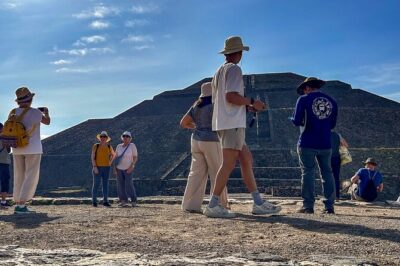
Teotihuacan, Guadalupe Shrine & Tlatelolco Day Tour with Lunch
Read our review →
Xochimilco, Coyoacan and Frida Kahlo with Optional Lunch
Read our review →
Balloon flight + Breakfast in cave + Pyramids + Pick up CDMX.
Read our review →
Teotihuacan pyramids morning or afternoon without tourist traps
Read our review →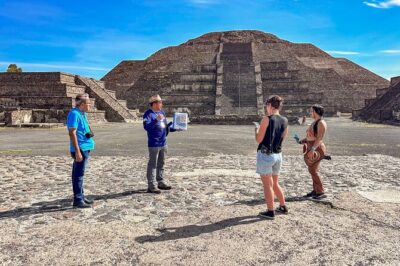
Teotihuacan Early Access Guided Tour with optional Lunch
Read our review →
Balloon flight + pick up in CDMX + Breakfast in Cave + Pyramids
Read our review →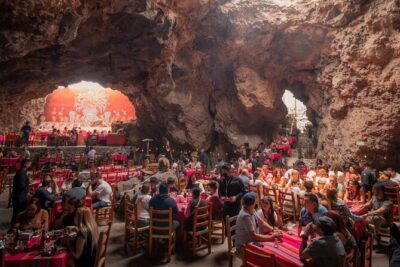
Balloon Flight + Cave Breakfast + Pick Up from CDMX or We Fly
Read our review →
Teotihuacan, Tlatelolco & Guadalupe Shrine Tour
Read our review →Browse the lists this tour appears in