
Reviewed · SCUBA DIVING
Two Tanks Scuba Diving for Beginners in Cancun
See Cancun from below the surface. This five-hour beginner scuba experience combines a pool lesson with two open-water outings: one at the MUSA Underwater Museum and another at Manchones Reef. You do not need certification, but you must swim and complete the required water skills safely.
I like the patient instruction, especially the way guides such as Lorena, Marin, and Carolina help nervous first-timers settle in. I also like the small maximum group of eight, which gives you a better chance of receiving personal attention than you would on a large boat. The main drawback is the early start and the medical restrictions, which rule out this activity for people with several health conditions.
In This Review
- Key points to know before booking
- What the Cancun morning looks like
- Pool training before the boat
- Getting fitted with the scuba equipment
- The boat ride to MUSA
- First stop: MUSA Underwater Museum
- Second stop: Manchones Reef
- Why the small group makes a difference
- Photos, videos, and what is not included
- Timing, flights, and practical planning
- Who should book this Cancun experience
- Should you book it?
- FAQ
- Do I need scuba certification for this experience?
- What time does the activity begin and end?
- Where is the meeting point?
- What scuba equipment is included?
- Can children participate?
- Can I fly after the activity?
- What happens if the weather cancels the outing?
Key points to know before booking
- Pool practice comes first: You learn basic theory and practice scuba skills before heading into the sea.
- Two very different underwater stops: MUSA brings cultural interest, while Manchones Reef focuses on marine life.
- Small groups matter: The maximum is eight people, and some outings have had one instructor for only a few guests.
- Patient guides help with nerves: Lorena and Marin are often praised for calm instruction, humor, and close attention.
- Plan around your flight: You must wait 18 to 24 hours after scuba before boarding an airplane.
- Bring motion-sickness medicine: The boat can be rough, and taking anti-nausea pills one or two hours before departure is advised.
What the Cancun morning looks like
You check in at 8:00 a.m. at Hotel Sotavento Cancun, at Kilometer 4 on Boulevard Kukulcan in the Hotel Zone. The activity ends at the same place, usually around 1:00 p.m. Hotel transportation is not included, so you need to arrange your own way to the meeting point.
The early start is sensible. It leaves enough time for health screening, instruction, pool work, equipment fitting, the boat ride, and two tank outings without turning the day into a marathon. Still, this is not a casual late-morning beach activity. You should arrive ready to focus.
At check-in, you complete a medical questionnaire. Be honest and careful here. Asthma, heart or brain problems, high blood pressure, lung lesions, organ transplants, diabetes, epilepsy, or surgery within the past year are listed as reasons you cannot take part. The operator also requires a moderate level of fitness and the ability to swim.
The age range is 10 to 65. That makes this possible for older children and many adults, but it is not suitable for every family member. If someone in your group cannot perform the required water skills, the activity cannot continue for that person, and the supplied terms state there is no refund in that situation.
More Scuba Diving in Cancun
- Diving in the Mexican Caribbean for Beginners | 2 Tanks 2 Dives | All Inclusive
★ 5.0 · 431 reviews - Scuba Diving Under Water Museum and Reef for beginners
★ 5.0 · 189 reviews - Cancun: Scuba Diving for Beginners, 2 Dives
★ 5.0 · 184 reviews
Pool training before the boat
The pool session is the part I consider most important for a first-time scuba guest. Rather than being sent straight into open water with unfamiliar equipment, you receive a basic theory lesson and practice essential skills with a qualified instructor.
You learn how the equipment works, how to breathe through the regulator, and how to manage basic underwater problems. The exact lesson can vary by instructor, but the purpose is clear: you should feel comfortable enough with the equipment to concentrate on your surroundings later.
This preparation has been especially useful for nervous beginners. Several guests found the instructors patient when breathing felt awkward or when fear set in. One beginner described struggling to time breathing in the pool and becoming tired. The instructor noticed the problem quickly, adjusted the technique, and helped the student continue.
That is the kind of attention you want. Scuba is not hard because the equipment is mysterious. It is hard because breathing underwater feels unnatural at first. Good instruction gives you time to adjust without making you feel foolish.
Lorena receives particular praise for clear explanations and a calm manner. Marin is also described as funny but serious about safety. That balance helps. A little humor can lower the tension, but you still want an instructor who treats the water skills with care.
If you panic or feel overwhelmed in the pool, speak up immediately. Do not try to hide it to keep the schedule moving. The pool is the safest place to pause, ask questions, and decide if you are ready for the sea.
Getting fitted with the scuba equipment
The $169 price includes the main equipment you need: a buoyancy control device, regulator, mask, fins, and wetsuit. Staff fit the fins and equipment before departure, and the wetsuit adds warmth and some protection in the water.
You should bring your identification, towel, swimsuit, and anything else you need for personal care. Hotel transportation is not included. Sunscreen and sunblock are not allowed because of coral protection, so plan your sun protection around clothing and the shaded areas available at the meeting point or boat.
The equipment has been well received, but personal comfort still depends on a proper fit. Tell the staff if your mask leaks, your fins pinch, or the wetsuit feels too tight. Small annoyances become much more distracting once you are underwater.
There is limited advice about storage on the boat, so bring only what you need. One useful tip is to store valuables before departure or use a waterproof sack to keep belongings dry. Phones, wallets, and towels do not mix well with spray.
The boat ride to MUSA
The boat leaves around 9:30 a.m. The supplied information describes a small boat setup, and one group reported six guests with three instructors, plus the captain and two crew members. That is a much more personal arrangement than a large party boat carrying several groups at once.
The boat is also the part most likely to test your stomach. Conditions can be choppy, and one person described rough seas after a period of storms. Anti-nausea tablets taken one or two hours before boarding are recommended. If you are prone to motion sickness, this is not a suggestion to ignore.
Once you reach the site, the water may feel easier than the ride. Still, sea conditions can affect comfort and visibility, and the experience requires good weather. If poor weather forces a cancellation, you are offered another date or a full refund.
The crew can help you get ready, but you should remain an active part of the process. Check your mask, regulator, and other gear. Listen closely to the hand signals and safety instructions. Underwater, clear communication depends on those signals and on paying attention to your guide.
Same base, a different sort of day:
- Chichen Itza, Cenote, and Valladolid Tour
★ 5.0 · 24,293 reviews - Chichen Itza, Cenote & Valladolid Tour with Tequila and Lunch
★ 4.5 · 15,789 reviews - Cancun: Chichen Itza, Cenote & Valladolid Tour with Lunch
★ 4.6 · 6,722 reviews - Early morning Chichen Itza Tour: Cenote and Tequila Tasting
★ 5.0 · 6,657 reviews
First stop: MUSA Underwater Museum
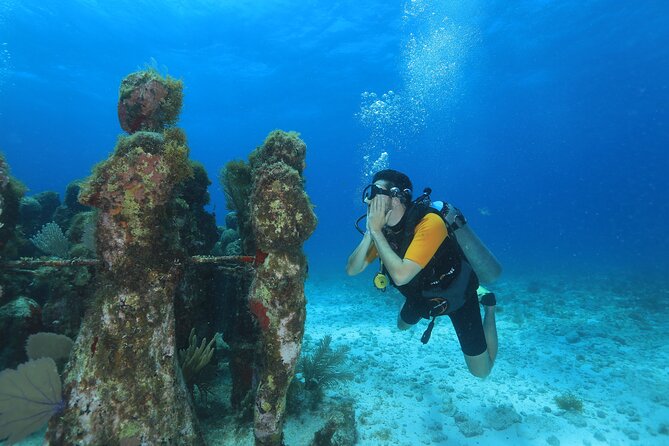
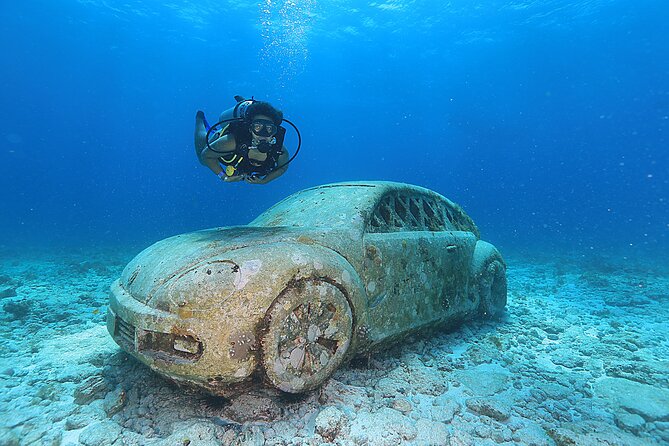
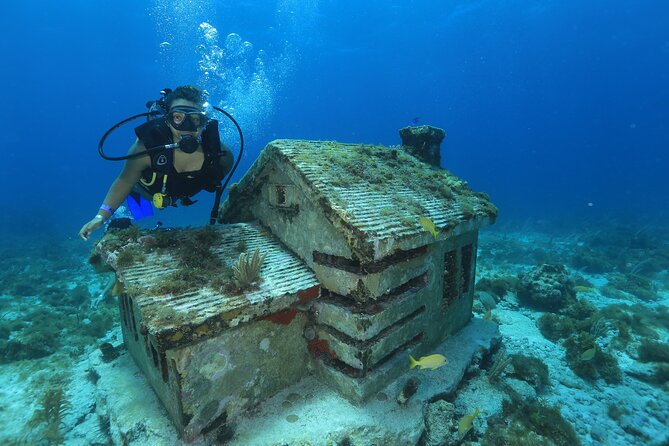
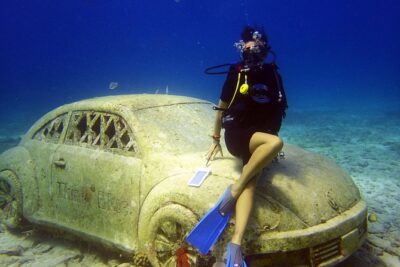
The first tank is at MUSA, the Museo Subacuático de Arte. Its appeal is not only the water itself. You are looking at an underwater collection of sculptures, an unusual meeting point between art and the sea.
The statues give first-time scuba guests something to focus on while they get used to breathing below the surface. You move through an environment that feels different from a standard reef outing, with human-made forms surrounded by marine growth and fish.
MUSA is a strong choice for the first stop because it offers a clear visual subject. You can take in the figures, practice following your guide, and start noticing how movement and buoyancy work together.
Do not expect an art museum in the normal sense. You are not strolling from room to room with dry feet and a guidebook. Visibility, current, group spacing, and your own comfort will shape what you see. The experience is best understood as a short underwater route through an evolving outdoor installation.
Your guide may point out details that are easy to miss. The value of having an instructor close by is not only safety. A guide who knows the site can direct your attention to marine life hiding around the sculptures and can help you avoid drifting past the most interesting features.
Second stop: Manchones Reef
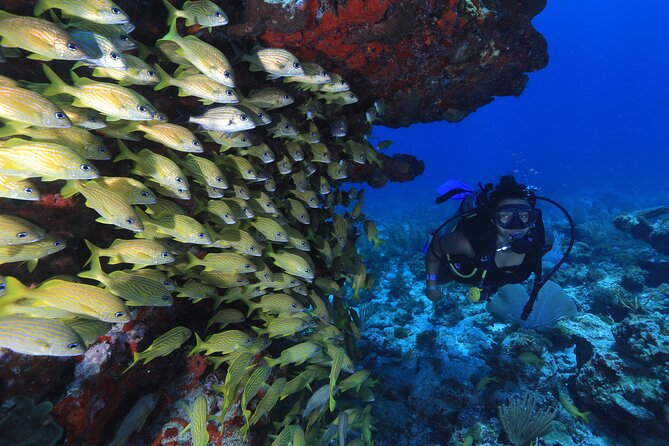
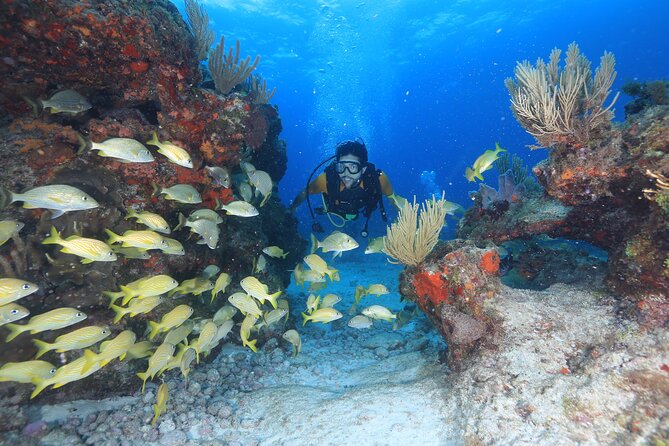
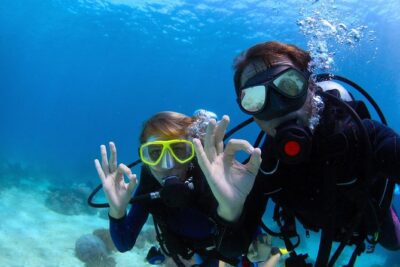
The second tank is at Manchones Reef, and this is where the natural side of the outing takes over. The reef is described as the stronger stop for marine life, with schools of fish, lobsters, eels, stingrays, turtles, and other creatures possible in the area.
You might see a nurse shark, octopus, moray eel, puffer fish, or sea turtle, but wildlife is never guaranteed. The right attitude is to watch carefully rather than chase a checklist. Guides such as Marin and Lorena know where to look, including spaces under rocks and among the coral.
A flashlight can help reveal small creatures tucked into darker areas. One guide used a light to search under rocks, turning an ordinary-looking patch of reef into a closer look at hidden life. Your own task is simple: stay near the guide, move slowly, and keep your hands off the coral.
Manchones is also where the difference between a guided experience and an unsupervised attempt becomes clear. Your instructor can point out a creature with hand signals, indicate where to look, and monitor your comfort at the same time. One guest did wish the guide had watched the group more closely, so you should still stay aware of your position and not assume the instructor can solve every problem instantly.
The second tank may feel more relaxed because you have already completed one underwater outing. You know how the mask feels, how to breathe through the regulator, and how to follow the group. That extra familiarity can make the reef seem more rewarding.
Why the small group makes a difference
The maximum group size is eight, but the practical setup may be smaller. Some outings have paired one instructor with three guests, and one couple even had an instructor and guide team focused closely on them.
That matters most if you are new to scuba. A smaller group makes it easier for the guide to notice nervous body language, check your position, point out wildlife, and answer questions. It also reduces the chance that you will spend the whole outing trying to keep track of a large crowd.
The small format does not mean you get a private tour every time. Group composition and instructor assignments can vary. One account described instructors managing several students at once, so you should stay close and follow directions rather than expecting constant one-to-one attention.
The strongest pattern is the staff’s calm approach. Lorena, Marin, and Carolina are repeatedly singled out for patience, organization, humor, and attention to safety. Carolina also helps with check-in and equipment fitting. That combination is particularly useful for a first scuba experience, when the pool lesson and emotional support can matter as much as the location.
Photos, videos, and what is not included
Photos and videos are optional and cost extra. Several guests were pleased with the quality, especially when their own GoPro was unreliable or when managing a camera felt like too much while learning scuba skills.
I can see the value. A first-time guest is already trying to control breathing, position, and equipment. Adding a camera can make the experience busier and may distract you from the reef. An instructor who is also an underwater photographer can capture images while you focus on staying calm and following the group.
You should not assume the photo package is part of the $169 price. It is an additional purchase. If you have your own camera, you can bring it, but the supplied experiences show why a staff photographer may produce better results, particularly during a first outing.
The base price does include the pool lesson, basic theory, full scuba equipment, wetsuit, and two tank outings. In value terms, that is a fair package for someone who wants a one-day introduction without paying for a full certification course. It is less useful if you already hold certification and want advanced routes, longer bottom time, or a specialized technical outing.
Timing, flights, and practical planning
The experience lasts about five hours, from the 8:00 a.m. check-in until your return around 1:00 p.m. The timing works well as a half-day plan, but do not schedule an afternoon flight simply because the boat is due back at one.
You need to wait 18 to 24 hours after scuba before taking an airplane. If you are flying home the same day or the following morning, choose another activity instead. This rule is one of the most important pieces of planning for your Cancun trip.
Free cancellation is available if you cancel at least 24 hours before the start time. Changes made inside that window are not accepted, and a late cancellation is not refunded. Weather can also stop the outing, in which case you receive the choice of another date or a full refund.
The activity is offered in English and confirmation is sent at booking. The meeting point is near public transportation, but you are responsible for reaching Hotel Sotavento. Give yourself enough time to arrive by 8:00 a.m., especially if you are coming from another part of the Hotel Zone.
Who should book this Cancun experience
I would choose this for a first-time scuba guest who wants a guided introduction rather than a classroom-only session. It also suits a certified person who has not been underwater for years and wants a refresher before returning to the sea.
Families can book it for children aged 10 and older, provided everyone meets the swimming, health, and water-skill requirements. Couples and solo visitors also fit the format well because the small group can make the outing feel personal even when you arrive alone.
I would not choose it if you cannot swim, have one of the listed medical conditions, dislike boat motion, or need to fly within 18 to 24 hours. It is also not a substitute for scuba certification. You learn enough for this supervised activity, but the experience does not turn you into a certified diver.
Should you book it?
Yes, if you want a well-supported first taste of scuba and can meet the health, swimming, age, and flight restrictions. The combination of pool practice, MUSA sculptures, Manchones Reef, included equipment, and a maximum of eight people gives the $169 price solid value.
Book it with realistic expectations. The sea may be choppy, wildlife cannot be promised, sunscreen is not allowed, and the extra photo package costs more. But if you arrive rested, take motion-sickness medicine, listen carefully in the pool, and speak up when nervous, this is a strong way to see two very different sides of Cancun underwater.
FAQ
Do I need scuba certification for this experience?
No. The activity is designed to teach basic scuba skills in one day, so certification is not required. You must still complete the theory and pool practice and perform the required skills safely.
What time does the activity begin and end?
Check-in begins at 8:00 a.m. The boat departs around 9:30 a.m., and you usually return to the same meeting point around 1:00 p.m.
Where is the meeting point?
The meeting point is Hotel Sotavento Cancun, Kilometer 4, Boulevard Kukulcan, in Cancun’s Hotel Zone. The activity ends back at this location.
What scuba equipment is included?
The price includes a buoyancy control device, regulator, mask, fins, and wetsuit. Basic theory and pool lessons are also included.
Can children participate?
Children must be at least 10 years old. The maximum listed age is 65.
Can I fly after the activity?
You should wait 18 to 24 hours after scuba before taking an airplane. Plan your departure around this restriction.
What happens if the weather cancels the outing?
If poor weather causes cancellation, you are offered another date or a full refund. The same choice applies if the minimum number of participants is not reached.
Newly listed around Cancun
- Tour Isla Mujeres excursion in Collective Transparent Boat★ 5.0 · 61 reviews
- Whale Shark & Manta Ray Snorkel -(May-Sept) Only 10pp per Boat★ 4.5 · 34 reviews
- Isla Mujeres Snorkeling Adventure at the Underwater Museum★ 4.5 · 219 reviews
- Snorkeling in Isla Mujeres and Underwater Museum★ 4.5 · 69 reviews
- Scuba Diving Adventure WITHOUT CERTIFICATION! Try it today!★ 5.0 · 57 reviews
- Snorkel Tour at Musa and Manchones Reef★ 4.5 · 38 reviews
- SPECIAL! Snorkel at MUSA – The Underwater Museum Reservation★ 4.5 · 34 reviews
- PADI Discover Scuba Diving for divers without certification★ 5.0 · 77 reviews
Scuba Diving, compared.
Diving in the Mexican Caribbean for Beginners | 2 Tanks 2 Dives | All Inclusive
Read our review →
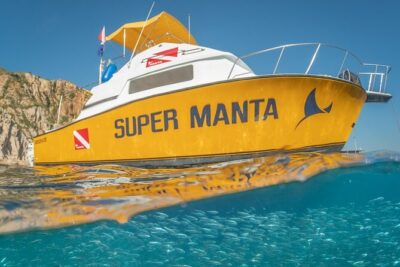
2-Tank Scuba Dive in Cabo San Lucas Reserve for Certified Divers
Read our review →
Discover Scuba Diving & Beach Club with Transportation In Riviera Maya
Read our review →
SeaTrek Underwater Helmet Diving Experience in Downtown Cozumel
Read our review →Browse the lists this tour appears in