
Reviewed · MUSEUMS
Anthropology Museum Guided Tour
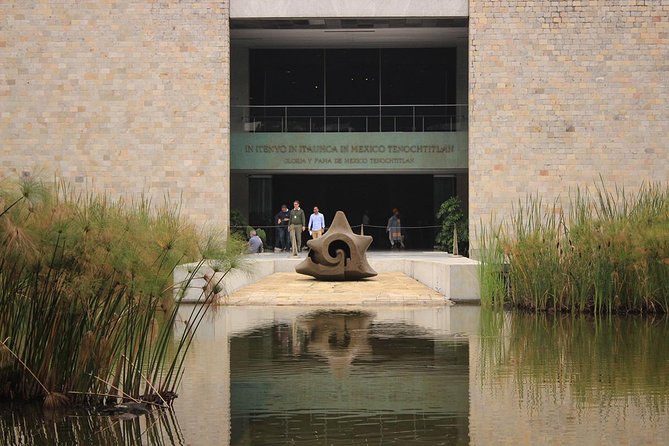
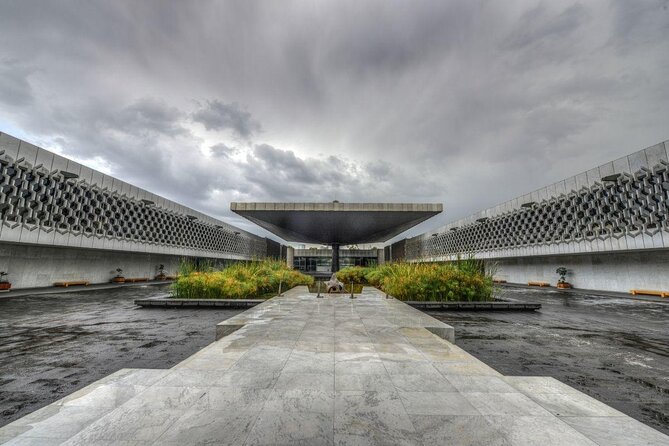
History comes alive under one giant umbrella. I like this tour because a guide gives order to an enormous collection, and because admission is included in the $39 price. The morning schedule also leaves your afternoon open for Chapultepec or other Mexico City sights. My main concern is consistency: some guides are excellent, while others have been hard to understand or poorly organized.
The National Museum of Anthropology is far too large to absorb quickly. I find a good guide especially useful here because many displays offer limited English explanation, and the objects make more sense when you know who made them, where they lived, and how their worlds connected. Guides such as Alexa, Alan, Ligia, Leonardo, Antonio, Hector, and Lili have earned especially warm praise for clear storytelling and strong command of Mexican history.
The tradeoff is that this is a group tour, with up to 25 people. Late arrivals may miss the group entirely, and the starting process can be confusing. If you arrive early, listen well, and get a strong English-speaking guide, the tour can be a terrific introduction. If the guide’s English or organization falls short, the same two and a half hours can feel frustrating.
In This Review
- Key Points Before You Book
- Why This Museum Needs a Guide
- The Stone of the Sun and the Mexica Galleries
- Olmec Heads and the Civilizations of the Gulf Coast
- Maya Tombs, Chichen Itza, and the Southern Galleries
- A Museum That Connects Past and Present
- What the Two-and-a-Half-Hour Route Feels Like
- The Guide Makes or Breaks the Experience
- Timing, Tickets, and the Late Arrival Risk
- Is $39 a Fair Price?
- Who Should Book This Tour?
- Should You Book It?
- FAQ
- Where does the Anthropology Museum tour start?
- Where does the tour end?
- How long does the tour last?
- Is museum admission included?
- Is the tour offered in English?
- How large can the group be?
- Can I bring a backpack, food, or drinks?
Key Points Before You Book
- The Stone of the Sun is only one part of the experience: You will also see Olmec heads, Maya objects, reconstructions, and a model of Tenochtitlan.
- A guide gives the museum a timeline: The tour connects the Olmec, Teotihuacan, Maya, Toltec, and Mexica worlds instead of leaving you to sort out the sequence alone.
- The $39 price includes admission: You do not pay a separate museum entrance fee, which makes the cost reasonable if the guiding is strong.
- This is not reliably a private tour: The group can reach 25 people, and some experiences have felt much larger or less orderly than expected.
- Morning timing is useful: The tour lasts about 2 hours and 30 minutes, leaving the rest of the day for Chapultepec, the castle, or central Mexico City.
- Arrive early and travel light: Food, drinks, and backpacks are not allowed inside. Only a handbag is permitted, and a group may leave without latecomers.
Why This Museum Needs a Guide
Mexico City’s National Museum of Anthropology is not a quick stop with a few famous objects. It is a vast survey of Indigenous civilizations connected to present-day Mexico and, in some cases, to territory that is now part of the southwestern United States.
The ground-floor permanent rooms cover major pre-Columbian cultures. You will move through different regions, periods, artistic styles, religious ideas, and political systems. Without a plan, it is easy to admire a carved figure, read a label, and then forget how it fits into the larger story.
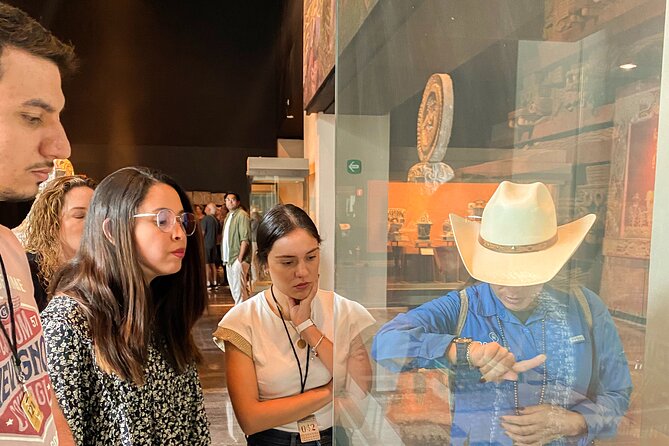
That is where this experience can earn its price. A strong guide begins with geography and time, then places the objects inside that frame. Alan, for example, has been praised for starting with a broad view of the region before moving into particular cultures. That method matters. It helps you understand that the Maya, Teotihuacan, and Mexica were not simply chapters in one straight-line civilization.
I also like the way the best guides use more than the museum labels. Alexa has used photographs and drawings to explain how buildings were constructed. Gibran, also identified as Alex, brought a binder of images and examples to help explain the material. These additions can turn a difficult display into something you can picture.
The museum’s own labeling is not always enough for English-speaking visitors. Some information is in Spanish only, and the number of English explanations varies. You can certainly walk through by yourself, but I think a well-spoken guide gives you a much firmer starting point.
More museum visits in Mexico City:
- CDMX: Xochimilco, Coyoacan, Frida Kahlo Museum & Murals Tour
★ 4.4 · 3,025 reviews - Chapultepec Castle & Anthropology Museum Tour
★ 4.5 · 1,348 reviews - Frida Kahlo VIP [Museum Tickets Included] Bike, Markets & Churros
★ 5.0 · 1,072 reviews
The Stone of the Sun and the Mexica Galleries
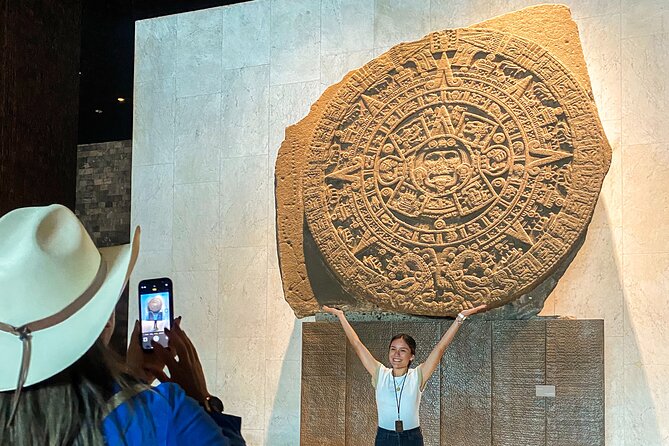
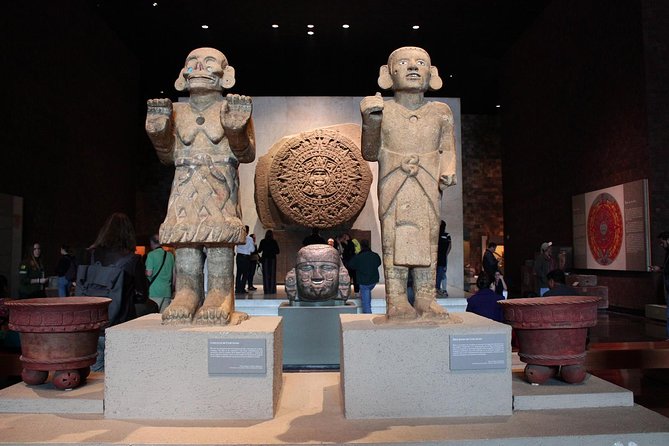
The Stone of the Sun is the museum’s most famous object, and it deserves its reputation. It is often called the Aztec Calendar, though that nickname can create confusion. A guide can explain what the carving represents and place it within Mexica religious and political life instead of treating it as a giant stone curiosity.
The surrounding Mexica material is just as important. The museum presents a model of Tenochtitlan, the former Mexica capital built where central Mexico City now sits. This model gives you a useful visual link between the ancient city and the modern capital outside the museum walls.
I find this connection one of the tour’s strongest features. You are not looking at an isolated past. The old capital occupied the area beneath today’s city center, and the museum helps you see how Mexico City grew over an earlier urban world.
A guide can also help prevent timeline mix-ups. Tenochtitlan and Teotihuacan are often discussed together by visitors because both were major cities, but they belong to different periods. The best presentation makes those differences clear with maps, dates, and geography. A weaker one may jump between cities and cultures without enough structure.
This is a good example of why the guide matters more than the basic admission ticket. The objects are impressive on their own, but the explanation determines how much you take away.
Olmec Heads and the Civilizations of the Gulf Coast
The giant Olmec heads are among the museum’s most memorable sights. These enormous stone faces came from the jungles of Tabasco and Veracruz, and their scale alone makes them worth seeking out.
A guide can point out why the heads are important without reducing them to a simple mystery. You may learn how they fit into the Olmec world, how far the stones had to be moved, and why they continue to attract attention. The value is not only in hearing facts, but in having someone direct your eyes toward details you might otherwise miss.
The museum presents the Olmec material as part of a wider sequence of cultures rather than as a disconnected opening act. That broader view is useful, especially if this is your first serious visit to a Mesoamerican museum.
I would pay attention to how your guide handles chronology here. A clear guide will explain the relationship between earlier Olmec traditions and later civilizations without implying that one culture simply turned into another. The museum covers a long span of time, and careful wording makes a big difference.
Maya Tombs, Chichen Itza, and the Southern Galleries
The Maya rooms bring a different set of questions. The collection includes treasures associated with the Maya civilization, including material recovered from the Sacred Cenote at Chichen Itza. Reconstructions of Maya tombs add a sense of place that individual objects cannot provide.
This part of the museum benefits from patient explanation. Maya civilization covered a broad area and developed across many centuries. A guide can help you keep the geography in view while explaining architecture, ritual practices, writing, and burial customs.
I would not expect the tour to cover every object in every room. Two and a half hours is enough for a guided introduction, not a complete museum study. The most effective guides focus on major pieces and use them to explain larger ideas.
Some guides give you time to look around a room on your own before explaining selected objects. That can work well when the instructions are clear. It works less well if the guide waits until after your independent viewing to discuss the very pieces you have already passed without telling you what to watch for.
If you are especially interested in Maya archaeology, plan to spend extra time after the tour. The guided route can give you the framework, then you can return to the rooms that caught your attention.
A few more Mexico City runs worth comparing
- Teotihuacan, Guadalupe Shrine & Tlatelolco Day Tour with Lunch
★ 5.0 · 11,603 reviews - Xochimilco, Coyoacan and Frida Kahlo with Optional Lunch
★ 4.5 · 7,320 reviews - Balloon flight + Breakfast in cave + Pyramids + Pick up CDMX.
★ 5.0 · 6,335 reviews - Teotihuacan pyramids morning or afternoon without tourist traps
★ 5.0 · 6,186 reviews
A Museum That Connects Past and Present
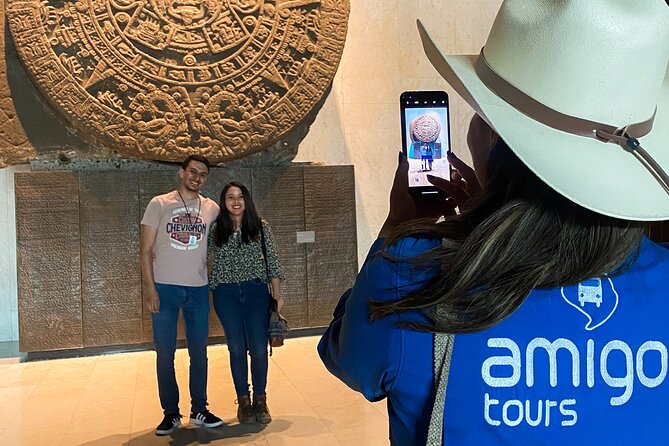
The museum’s purpose is bigger than displaying old objects. It links archaeology, national identity, scholarship, and politics. Its collections help explain how Mexico presents its Indigenous past and how those cultures continue to influence contemporary Mexican life.
That connection is one reason I would choose a guide rather than simply treating the museum as a gallery of beautiful stonework. The guide can explain why an artifact mattered in its own time and why it matters in Mexico today.
The layout also helps. The permanent rooms on the ground floor cover cultures from across the territory of present-day Mexico, along with areas that were once part of Mexico and are now in the southwestern United States. Visiting exhibitions generally look beyond Mexico to other major world cultures.
You may find that the temporary exhibition changes your route or adds another subject to your visit. The guided portion focuses on the permanent archaeological collection, so do not assume the tour will cover every gallery.
What the Two-and-a-Half-Hour Route Feels Like
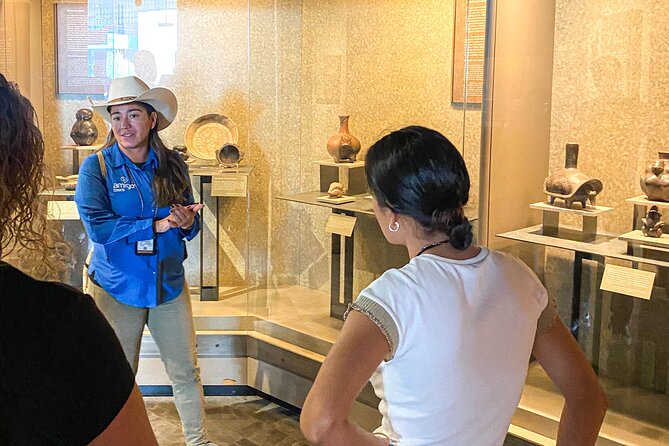
The experience begins at the museum on Avenida Paseo de la Reforma in Chapultepec. It ends at the same meeting point, and the location is near public transportation.
The stated duration is approximately 2 hours and 30 minutes. That is long enough for a serious overview, but the museum is large enough that you could spend much longer inside. I recommend viewing the tour as your orientation, not your entire museum day.
The best guides create a clear arc. They establish the region, explain the sequence of cultures, stop at major objects, and leave room for questions. Alan has been praised for going over the scheduled time, while Gibran and several others have also provided unusually thorough explanations.
That extra time should be treated as a pleasant possibility, not a promise. The official duration is still about two and a half hours, and group conditions can affect the pace.
Audio equipment may be used when groups are larger. This is helpful in theory, but the quality of the equipment and the guide’s delivery matter. Some English-speaking visitors have had trouble understanding guides despite their strong subject knowledge. If you struggle to follow the narration, the experience loses much of its value.
The Guide Makes or Breaks the Experience
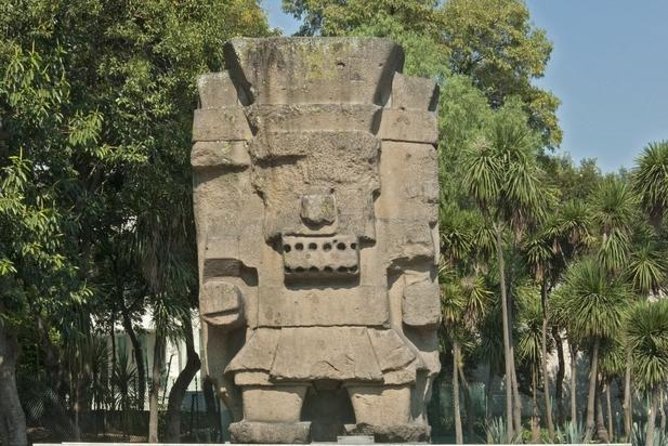
The clearest pattern in this tour is the wide difference between guides. When the guide is prepared, clear, warm, and open to questions, the experience can feel like a private lesson inside a public museum.
Alexa has been praised for combining history with photos and drawings. Alan has been singled out for both depth and patience. Ligia has received strong praise for answering questions in English and Spanish, while Leonardo has been appreciated for linking interesting facts into a clear route. Antonio and Lili have also been described as warm, passionate, and effective storytellers.
Those strengths are not minor details. A guide who can explain the difference between cultures, show where cities were located, and answer questions turns a massive collection into something manageable.
The weaknesses are equally important. Some English presentations have been difficult to follow because of accent, pacing, or unclear phrasing. One guide was described as speaking continuously without pausing for questions. Another group found the narration disorganized, with sudden jumps between regions and periods.
The group size can add to the problem. With up to 25 people, the guide may spend substantial time gathering the group, managing crowd movement, or repeating information. Some experiences have felt like groups of more than 20, which is not ideal in crowded galleries.
I would book this tour only if I accepted that guide quality is not fully predictable. The strong experiences are excellent, but the weak ones are not merely average. They can interfere with the museum itself.
Timing, Tickets, and the Late Arrival Risk
The morning departure is one of the practical advantages. After the museum, you can continue through Chapultepec, visit Chapultepec Castle, or head toward another part of the city. Starting early also helps you use the cooler, quieter part of the day.
Arrive well before the stated meeting time. Mexico City traffic can be slow, and the group may not wait. A late arrival of only ten minutes has resulted in a missed tour, even when notice was sent through the booking app.
The meeting point can also require attention. Some people have found it unclear where to identify the guide, and the ticket queue has caused confusion. Look for the tour representative before joining a general admission line, and confirm the guide’s name and group before you wait.
You cannot bring food, drinks, or a backpack into the museum. Only a handbag is allowed. Keep your belongings simple, and do not arrive carrying a daypack that you expect to take inside.
The tour is open to most participants, and confirmation is sent at booking. Food and drinks are not included, so plan to eat before or after the museum rather than expecting a refreshment stop during the tour.
Is $39 a Fair Price?
At $39 per person, the price includes both museum entrance and a professional guide. That is a fair arrangement if you want a structured introduction and prefer not to work through Spanish-only labels on your own.
The value depends heavily on the guide. A strong two-and-a-half-hour explanation can save you from wandering through rooms without knowing what deserves attention. It can also give you the context to enjoy a second, slower visit later.
If you are already well read on Mesoamerican archaeology and comfortable reading Spanish, you may prefer to pay only for admission and explore at your own pace. The tour is most useful for first-time visitors, English-speaking visitors, and anyone who wants a clear historical framework.
Group discounts may be available, which can improve the price for families or larger parties. Still, check exactly what ticket type has been purchased for children. One family had a serious dispute when a child ticket was charged but later questioned by the guide.
Free cancellation is available if you cancel at least 24 hours before the start time. Changes or cancellations inside that window are not accepted for a refund.
Who Should Book This Tour?
I would recommend it to someone visiting the museum for the first time who wants help sorting out the Olmec, Maya, Teotihuacan, Toltec, and Mexica material. It is also a good fit if you want to understand the Stone of the Sun, Tenochtitlan model, and Maya displays without relying only on short labels.
Families can benefit because a lively guide may hold children’s attention better than a long self-guided walk. History and archaeology fans should also find the tour worthwhile, especially if the guide uses maps, photographs, or drawings.
I would hesitate if you strongly prefer small groups, need guaranteed fluent English, or dislike fixed pacing. The maximum group size is 25, and the quality of communication has varied.
Should You Book It?
Book this tour if you want structure and context. The museum is extraordinary, but its size and uneven English labeling can make a first visit feel scattered. A strong guide can explain the timeline, geography, and meaning behind the best-known objects in a way the displays cannot always do alone.
Arrive early, bring only a handbag, and treat the tour as an introduction rather than the final word. If you receive a guide like Alan, Alexa, Ligia, Leonardo, Antonio, or Lili, $39 is good value. If clear English, careful organization, and a small group are essential, compare other tour companies before committing.
FAQ
Where does the Anthropology Museum tour start?
The tour starts at the National Museum of Anthropology, located at Av. Paseo de la Reforma s/n in Chapultepec, Mexico City.
Where does the tour end?
The activity ends back at the museum meeting point.
How long does the tour last?
The tour lasts approximately 2 hours and 30 minutes.
Is museum admission included?
Yes. The price includes entrance to the National Museum of Anthropology and a professional guide.
Is the tour offered in English?
Yes. The experience is offered in English.
How large can the group be?
The maximum group size is 25 people.
Can I bring a backpack, food, or drinks?
No. Food, drinks, and backpacks are not allowed inside. Only a handbag is permitted.
Newly listed around Mexico City
- Ticket to Frida Kahlo Museum on CDMX★ 4.5 · 44 reviews
- Epic Centro Histórico Walking Tour★ 5.0 · 77 reviews
- Eat Like A Local By The Taco Mensch★ 5.0 · 55 reviews
- Eat and Explore Local Markets in Mexico City★ 5.0 · 83 reviews
- Authentic Lucha Libre Tour : Wrestling School, Tacos & Mezcal★ 5.0 · 162 reviews
- Express Tour to Teotihuacan Pyramids. Be the first to arrive!★ 4.5 · 62 reviews
- Ticket for the Frida Kahlo Museum★ 3.5 · 67 reviews
- Small Group: The Magical Colonial Towns of Taxco and Cuernavaca★ 4.5 · 46 reviews
Museums, compared.

Xochimilco, Coyoacan, Frida Kahlo Museum & Murals Tour
Read our review →
Chapultepec Castle & Anthropology Museum Tour
Read our review →![Frida Kahlo VIP [Museum Tickets Included] Bike, Markets & Churros](https://d1.introducingmexico.com/wp-content/uploads/frida-kahlo-vip-museum-tickets-included-bike-markets-churros-400x267.jpg)
Frida Kahlo VIP [Museum Tickets Included] Bike, Markets & Churros
Read our review →![Frida Kahlo VIP [Museum Tickets Included] Walk, Markets & Churros](https://d1.introducingmexico.com/wp-content/uploads/frida-kahlo-vip-museum-tickets-included-walk-markets-churros-400x267.jpg)
Frida Kahlo VIP [Museum Tickets Included] Walk, Markets & Churros
Read our review →
EXCLUSIVE TOUR Frida Kahlo Museum – SMALL GROUPS
Read our review →
Coba Multun-Ha Cenote Tulum and Mayan Museum Small Group
Read our review →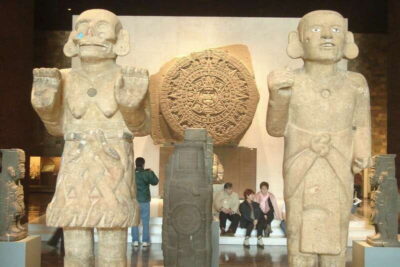
Frida Kahlo Museum Entry Ticket w/Digital Guide
Read our review →Browse the lists this tour appears in