
Reviewed · FOOD & DRINK
Learn How To Cook Mexican Food
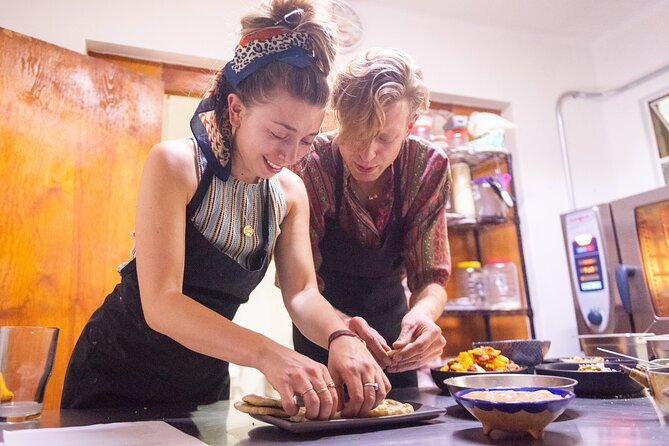
Dinner starts with your hands. This three-hour class in Roma Norte turns familiar Mexican ingredients into a full meal, while Chef Julieta Carrion explains the techniques behind salsa, masa, chiles, nopales, and more. I like the small maximum of eight people, which keeps the pace personal, and I like that you eat everything you prepare rather than watching a chef cook a sample meal.
The class also gives you written recipes to take home, a useful touch for anyone who wants to repeat the dishes later. The main consideration is the fixed 6:00 pm start and the three-hour commitment, so this works best when you can give your evening over to cooking and dinner.
In This Review
- Key points to know before booking
- Arriving at Tonalá 194 for a 6:00 pm class
- Why the eight-person limit matters
- Starting with masa, salsa, chiles, and cactus
- Making sopes from hand-shaped corn masa
- Preparing a fresh nopales salad
- Cooking tinga with chicken or oyster mushrooms
- Making papas con chorizo
- Finishing with chilaquiles rojos
- What the $149.28 price really includes
- Who will enjoy this class most
- Booking timing, cancellation, and practical details
- Should you book this Roma Norte cooking class?
- FAQ
- Where does the cooking class meet?
- What time does the class start?
- How long does the cooking class last?
- How many people can join the class?
- Is the class offered in English?
- What food will I prepare?
- Are ingredients and dinner included?
Key points to know before booking
- A maximum of eight people: The small group makes it easier to see demonstrations, ask questions, and work directly with the ingredients.
- A working pastry kitchen in Roma Norte: Chef Julieta teaches in the same professional kitchen used by her pastry business.
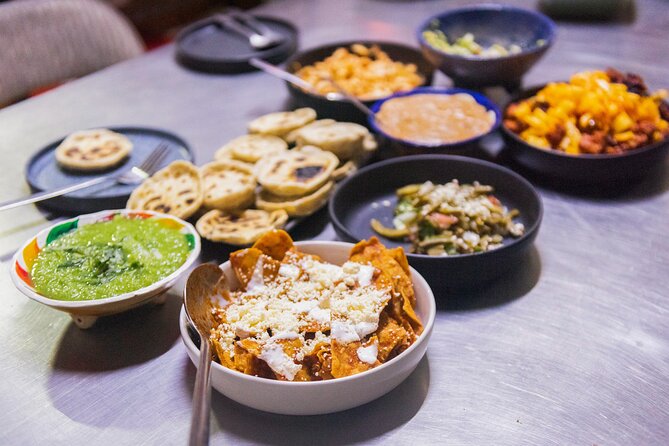
- Four substantial Mexican dishes: You prepare sopes, nopales salad, tinga, papas con chorizo, and chilaquiles rojos.
- Hands-on cooking, not a demonstration: You practice salsa, chiles, corn masa, and cactus preparation yourself.
- Vegetarian flexibility: Oyster mushrooms can replace chicken in the tinga.
- A meal and recipes included: Everything you cook is yours to eat, with containers available for leftovers and written recipes for home use.
Arriving at Tonalá 194 for a 6:00 pm class
The class meets at Tonalá 194 in Roma Norte, one of Mexico City’s most convenient neighborhoods for an evening outing. The location is near public transportation, but private transportation is not included, so you need to arrange your own way to the kitchen.
The timing is practical. A 6:00 pm start gives you an activity for the heart of the evening, and the class lasts about three hours. You are likely to finish around 9:00 pm, after preparing and eating the food. Plan your day accordingly, since this is not a quick market stop or a short cooking demonstration.
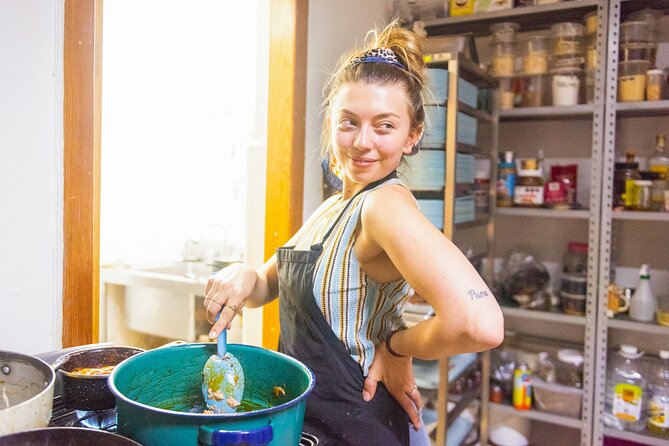
You enter a professional working kitchen rather than a purpose-built tourist venue. Chef Julieta Carrion owns a pastry business that supplies restaurants and coffee shops, and she uses the same kitchen for these cooking classes. That detail gives the experience a useful connection to Mexico City’s food trade. You are not simply in a classroom filled with decorative props. You are learning in a place where food is prepared for real businesses.
An apron is provided for each person. All ingredients are included, so you do not need to shop before arriving or bring special equipment. The class ends at the same location, which keeps the evening simple.
More Food Tours in Mexico City
- Historic Center Food Tour in Mexico City
★ 5.0 · 1,263 reviews - Lucha Libre Tickets & Tacos & Beer & Mezcal – BEST NIGHT EVER!
★ 5.0 · 1,077 reviews - Polanco Food Tour: The Bestselling Food Adventure in Mexico City
★ 5.0 · 881 reviews
Why the eight-person limit matters
A class capped at eight people has a different feel from a large group gathered around one demonstration table. You get more room to handle the masa, shape the sopes, stir the sauces, and ask for help when a texture does not look right.
That matters especially with Mexican cooking. A recipe can tell you the ingredients, but it cannot always explain how soft masa should feel in your hands or how much salsa is enough for a dish. The value here is in practicing those small judgments with guidance nearby.
The class is designed to move at an enjoyable pace. You are not expected to race through a long list of recipes. At the same time, you prepare enough food to create a complete dinner, so the evening has a clear purpose.
Chef Julieta’s role is another strong point. The available feedback describes her as professional, engaging, and friendly, and those qualities are important in a hands-on class. Cooking feels more comfortable when the instructor can explain a technique without making beginners feel clumsy. One especially useful outcome is confidence: you leave with methods you can try again, not just memories of someone else’s cooking.
Starting with masa, salsa, chiles, and cactus
The class begins with basic techniques that form the backbone of many Mexican home kitchens. You learn how to make a basic green salsa, work with fresh and dried chiles, handle corn masa, shape it by hand, and cook nopales.
These lessons are more valuable than a single recipe. Salsa teaches you how ingredients can be adjusted to your taste. The chile lesson helps you understand the difference between heat and flavor. Masa gives you a feel for one of Mexico’s most important staple foods. Nopales show you how cactus becomes a fresh, edible vegetable rather than just a plant you photograph from a distance.
The class also introduces nixtamalized corn dough in the preparation of sopes. Nixtamalization is the traditional process that gives corn masa its particular texture and flavor. You do not need a technical lecture to appreciate the result. Once the dough is in your hands, you can see why its softness and structure matter.
The written recipes are especially useful here. Techniques such as shaping masa or balancing salsa can be hard to remember from a single evening. Having the recipes afterward gives you a way to reconstruct the meal at home and keep practicing.
Making sopes from hand-shaped corn masa
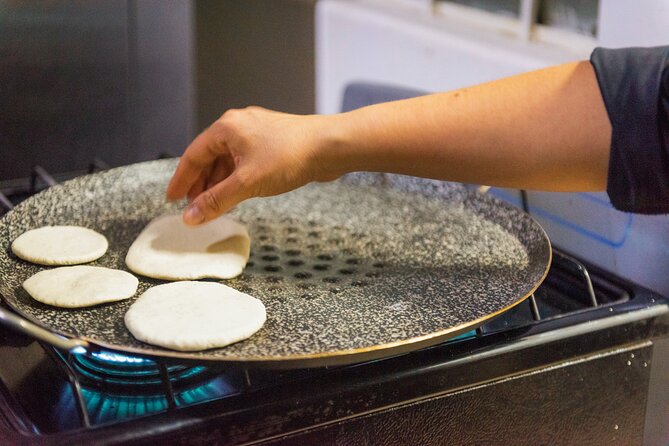
Sopes are round patties made from nixtamalized corn dough. You shape the dough, cook it, and top it with refried beans, salsa, onion, and cilantro if you like.
This is a good early dish because it brings several basic skills together. You work with masa, learn its texture, and create a sturdy base for toppings. The beans add substance, while salsa and herbs give the sope freshness and bite.
I like that the toppings are not presented as a rigid formula. Onion and cilantro are optional, so you can adjust the final dish to your taste. The result is simple food, but it teaches a useful lesson: Mexican cooking often depends on a few well-prepared ingredients assembled in the right proportions.
Sopes also make a satisfying first course because they are both familiar and hands-on. You can see the change from raw dough to a cooked corn base, then finish the dish yourself. It is the kind of preparation that rewards attention more than fancy equipment.
A few more Mexico City runs worth comparing
- Teotihuacan, Guadalupe Shrine & Tlatelolco Day Tour with Lunch
★ 5.0 · 11,603 reviews - Xochimilco, Coyoacan and Frida Kahlo with Optional Lunch
★ 4.5 · 7,320 reviews - Balloon flight + Breakfast in cave + Pyramids + Pick up CDMX.
★ 5.0 · 6,335 reviews - Teotihuacan pyramids morning or afternoon without tourist traps
★ 5.0 · 6,186 reviews
Preparing a fresh nopales salad
Nopales, or cactus paddles, are a staple in Mexican cooking. In this class, you prepare them as a salad, creating a fresher counterpoint to the richer dishes that follow.
For many people, nopales are the most unusual ingredient on the menu. That makes this course useful. You learn how a common Mexican food is handled and served, rather than treating it as an exotic sample. The salad is described as fresh and nutritious, and its lighter character helps balance the evening’s meat, potatoes, masa, and tortilla chips.
The cactus also provides a practical lesson in broadening your home cooking. You do not need to limit Mexican meals to tacos or guacamole. Nopales offer another vegetable option, and the class shows how they fit into an everyday meal.
Cooking tinga with chicken or oyster mushrooms
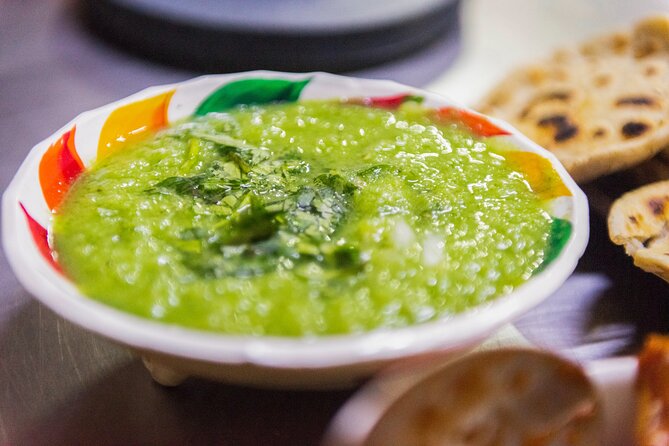
Tinga is the main dish built around smoked chipotles. You prepare it with chicken, or with oyster mushrooms if you prefer a vegetarian version.
The chipotles give the dish its smoky flavor and allow you to choose how mild or spicy you want it. That flexibility is helpful if you enjoy chile flavor but do not want an overly hot meal. It also lets you understand that Mexican food is not automatically fiery. Heat can be adjusted while the smoke and savory character remain.
The vegetarian substitution is a real advantage, not just a token alternative. Oyster mushrooms provide a different texture while allowing the same smoky seasoning to carry the dish. If you do not eat meat, you can still take part in the same preparation and receive a complete meal.
Tinga also shows how one seasoned filling can work across Mexican cooking. You learn how chipotle changes a dish and how a focused sauce can turn a basic protein or vegetable into something memorable. The class does not only hand you a finished plate. It gives you a method you can adapt later.
Making papas con chorizo
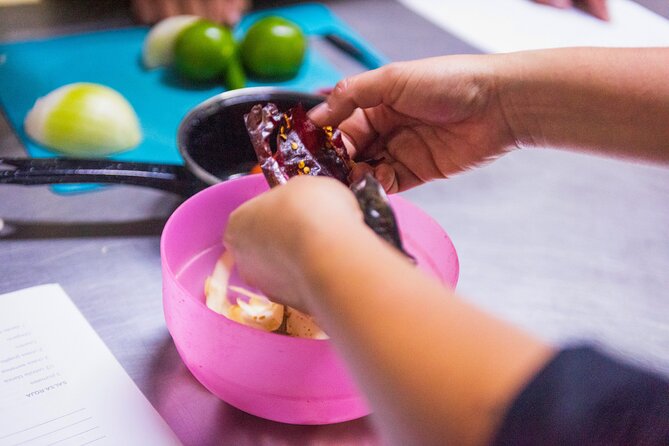
Papas con chorizo combines potatoes with a mildly spiced sausage. It is a direct, hearty dish, and it gives the class another chance to show how Mexican cooks build flavor from everyday ingredients.
Potatoes are familiar to most home cooks, but chorizo changes their character. The sausage adds seasoning and richness, while the potatoes make the dish filling. This is the kind of preparation that can work as part of a larger meal or as a practical home dinner.
The mild spice level makes papas con chorizo approachable. Alongside the chipotle-based tinga and red salsa for the chilaquiles, it creates a useful range of flavors rather than making every course taste hot.
I also appreciate the menu’s variety. You are not repeating the same tortilla preparation four times. You handle masa, cactus, chicken or mushrooms, sausage, potatoes, and tortilla chips. That gives you a wider picture of Mexican cooking in one evening.
Finishing with chilaquiles rojos
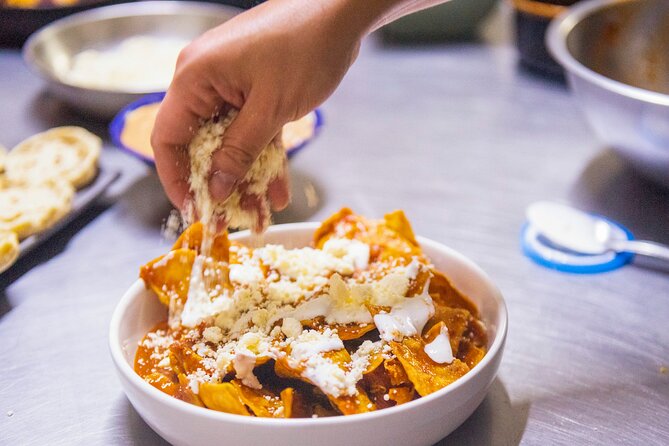
Chilaquiles rojos are crunchy tortilla chips dipped in red salsa and topped with fresh, thick crema. They make a fitting final dish because they depend on timing and texture.
The chips should retain some character while absorbing the red salsa. The crema adds coolness and richness, giving the dish a clear contrast between crisp, saucy, and creamy elements. It is a familiar Mexican comfort food, but preparing it yourself helps explain why the order of steps matters.
This dish also rounds out the color and flavor of the menu. Earlier, you work with green salsa and smoked chipotles. Here, red salsa gives you another chile-based preparation. You get to compare different sauces rather than treating salsa as one generic category.
Because chilaquiles are substantial, do not arrive expecting a light tasting menu. Between the sopes, nopales, tinga, potatoes with chorizo, and chilaquiles, you will have a proper dinner. The class states that everything you cook is for you to eat, and containers are provided if you cannot finish it all.
What the $149.28 price really includes
At $149.28 per person, this is not a bargain meal. You are paying for a three-hour lesson, a small group, an instructor, ingredients, kitchen use, an apron, a full dinner, and written recipes.
The strongest value comes from the combination of instruction and food. If you only wanted to eat these dishes, you could likely find less expensive options elsewhere in Mexico City. If you want to understand how the dishes are made and gain techniques you can repeat, the calculation changes.
The eight-person limit also supports the price. A small class gives you more direct practice than a large session where you mainly watch. The inclusion of all ingredients removes the extra cost and work of shopping, while the leftover containers mean the meal does not have to end when the class does.
I would view this as a good value for a first visit to Mexico City if food is a major part of your trip. It is less compelling for someone who already cooks Mexican food often and mainly wants a cheap dinner. The written recipes improve the long-term value, especially if you return home wanting to recreate the meal.
Who will enjoy this class most
I would recommend this experience to you if you like learning by doing. It suits beginners who want clear instruction, as well as home cooks who want to improve their handling of masa, chiles, salsa, and nopales.
It is also a strong choice for couples, friends, and small family groups who want a shared evening activity. The compact group size should make conversation easier than at a large cooking school.
Vegetarians have a clear option through the oyster mushroom tinga. Still, you should make sure your food needs fit the menu before booking, since the available details only specify that substitution and do not list other dietary adaptations.
This is not the right pick if you want a short activity, a market tour, or a class focused only on one signature dish. It is a full evening with several preparations and a meal at the end. You also need to get yourself to Roma Norte, since private transportation is not included.
Booking timing, cancellation, and practical details
The class is often booked about 24 days in advance, so I would not leave it until the last moment if your Mexico City dates are fixed. Confirmation arrives when you book, and mobile tickets are accepted.
The experience is offered in English, which makes the instruction easier to follow if you do not speak Spanish. It requires a minimum number of people to operate. If that minimum is not reached and the class is canceled, you are offered another date or experience, or a full refund.
You can cancel for a full refund up to 24 hours before the start time. Changes or cancellations made less than 24 hours before 6:00 pm are not accepted for a refund, and the cut-off follows Mexico City local time.
Should you book this Roma Norte cooking class?
Book it if you want more than a meal. The class gives you a small group, a named chef, a professional kitchen, a broad menu, hands-on practice, and recipes you can use later. The highest praise belongs to the friendly, professional teaching and the sense that you leave ready to try the dishes at home.
Skip it if your main goal is the lowest-cost dinner or if a three-hour evening class feels too long. At $149.28, the value depends on how much you care about learning the techniques.
For anyone who wants a practical introduction to Mexican home cooking, this is a well-shaped evening. You make food with your hands, eat what you prepare, and leave with more than a full stomach.
FAQ
Where does the cooking class meet?
The class meets at Tonalá 194, Roma Nte., Cuauhtémoc, 06700 Ciudad de México, CDMX, Mexico.
What time does the class start?
The class starts at 6:00 pm.
How long does the cooking class last?
The experience lasts approximately three hours.
How many people can join the class?
The class has a maximum of eight participants.
Is the class offered in English?
Yes. The experience is offered in English.
What food will I prepare?
You prepare sopes, nopales salad, tinga, papas con chorizo, and chilaquiles rojos. Tinga can use chicken or oyster mushrooms for vegetarians.
Are ingredients and dinner included?
Yes. All ingredients, an apron, and the food you cook are included. You can eat the meal after the class, and containers are provided for leftovers.
Newly listed around Mexico City
- Xochimilco : Island of the dolls, tequila and mezcal CDMX★ 5.0 · 102 reviews
- Xochimilco: Sanctuary of the Axolotl★ 4.9 · 58 reviews
- Xochimilco: Market, Food and Nature ¡All included! Tour★ 4.9 · 107 reviews
- Xochimilco: amanecer en kayak Ciudad de México★ 5.0 · 35 reviews
- Xochimilco & Colonial Coyoacan Trip★ 4.0 · 312 reviews
- Bike Tour in Mexico City★ 5.0 · 45 reviews
- Small Groups: Xochimilco and Coyoacan★ 4.0 · 37 reviews
- Museum of Anthropology: a look at Mexico’s past★ 5.0 · 52 reviews
Food & Drink, compared.

Cabo Beach Camel Ride, Mexican Buffet and Tequila Tasting
Read our review →
Early morning Chichen Itza Tour: Cenote and Tequila Tasting
Read our review →
4×4 ATV Adventure with Tequila Tasting and Mexican Buffet Lunch
Read our review →
Cancun ATV Jungle Adventure, Ziplines, Cenote and Tequila Tasting
Read our review →
Winner 2025 Downtown Vallarta Food Tour with Vallarta Food Tours
Read our review →
ATV Tour, Camel Ride, Tequila Tasting and Mexican Buffet Lunch
Read our review →
Cabo Migrino Beach and Desert ATV Tour plus Tequila Tasting
Read our review →
Food & Mixology Tour:Tequila,Tacos, Mezcal and Agave Cocktails
Read our review →Browse the lists this tour appears in