
Reviewed · MUSEUMS
Mexico City: Anthropology Museum Tour with Historian
Mexico’s past comes alive here. This three-hour tour turns the National Museum of Anthropology from a huge collection into one connected story, linking Olmec sculpture, Mexica engineering, Teotihuacán’s many peoples, and Maya writing. I especially like the focus on symbols and visual storytelling, because the objects become more than beautiful things behind glass. I also like the small-group format, limited to 10 people, with guides such as Natalia and Hector bringing serious academic training without sounding like a lecture hall.
The main consideration is time. Three hours is enough for the major halls and highlights, but not for the entire museum. You will move at a steady pace, and if you want to study every case or explore less famous cultures, you should plan to stay after the tour. At $175 per person, this is a premium museum visit, but the price makes more sense if you value expert interpretation and want to ask questions along the way.
In This Review
- Key points to know before you book
- Why a guide helps inside this enormous museum
- Starting with the museum’s architecture and courtyard fountain
- What Mesoamerica means, and why the term matters
- Textiles, agave, and the practical side of ancient life
- Ritual clothing and the long story of cultural exchange
- The Olmec colossal head and the problem of labels
- The Mexica galleries: the Sun Stone, Templo Mayor, and chinampas
- Teotihuacán as a city of many peoples
- Maya writing, portrait ceramics, and Pakal’s tomb
- How much value do you get for $175?
- Who should book this museum tour?
- Should you book it?
- FAQ
- How long is the Mexico City Anthropology Museum tour?
- What is included in the price?
- Is transportation included?
- Where do I meet the guide?
- Which languages are available?
- How large is the group?
- Is the tour wheelchair accessible?
Key points to know before you book
- The tour connects civilizations instead of treating each gallery as a separate stop.
- Natalia and Hector receive especially strong praise for clear explanations, humor, and academic depth.
- You will see major pieces including the Sun Stone, an Olmec colossal head, Teotihuacán art, and a replica of Pakal’s tomb.
- The museum’s fountain, murals, architecture, and courtyard are part of the story, not just background scenery.
- A three-hour visit covers highlights well, but you can remain in the museum afterward to continue on your own.
- The meeting point is the main lobby near the ticket booth, with a Walk Mexico logo identifying your guide.
Why a guide helps inside this enormous museum
The National Museum of Anthropology is not a place you casually finish in an hour. Its galleries cover a wide span of Mesoamerican cultures, and many displays assume that you already know how the pieces relate. Without a guide, it is easy to admire a carved face, a ceramic vessel, or a model city without grasping its place in the larger story.
This tour gives you that structure. You begin with a basic question: what connects peoples separated by great distances and long periods of time? From there, the guide shows how farming, trade, religious ideas, writing systems, materials, and artistic forms moved across the region.
I like this approach because it avoids the usual museum problem of collecting isolated facts. Instead of hearing that one civilization used agave and another built canals, you learn how natural resources and engineering shaped daily life. Instead of seeing the Sun Stone as a famous object, you learn why its name is misleading and what its imagery was meant to communicate.
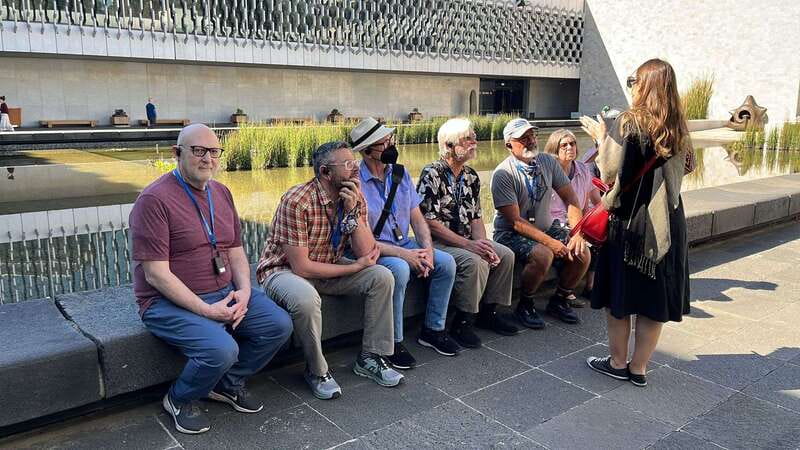
The guides are a major part of the value. Natalia is an art historian who uses photographs and visual aids to give difficult subjects a clear shape. Hector is a former college professor whose strong speaking voice and relaxed humor help hold a group’s attention. Both have been praised for answering difficult questions without becoming defensive or overly academic.
English and Spanish tours are available. Headsets are provided for large groups, though the regular group size is limited to 10 participants. That combination should make it easier to hear explanations near popular displays.
More museum visits in Mexico City:
- CDMX: Xochimilco, Coyoacan, Frida Kahlo Museum & Murals Tour
★ 4.4 · 3,025 reviews - Chapultepec Castle & Anthropology Museum Tour
★ 4.5 · 1,348 reviews - Frida Kahlo VIP [Museum Tickets Included] Bike, Markets & Churros
★ 5.0 · 1,072 reviews
Starting with the museum’s architecture and courtyard fountain
The tour begins in the museum itself, near the main lobby and ticket booth. Look for the guide carrying the Walk Mexico project logo. There is no hotel pickup or transportation, so you need to make your own way to the Anthropology Museum.
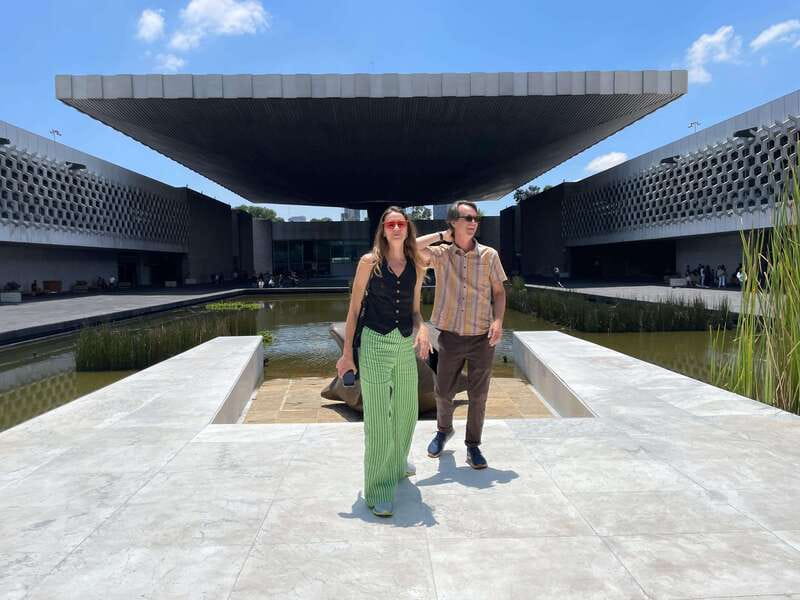
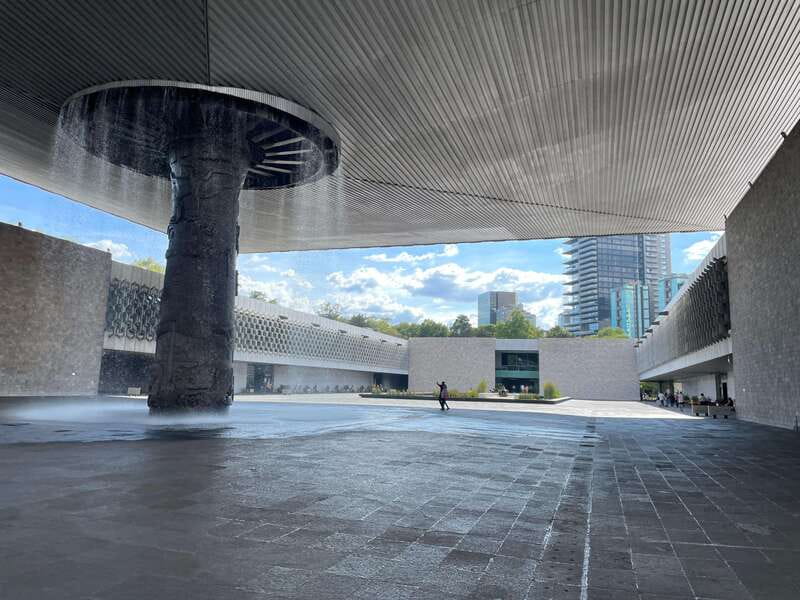
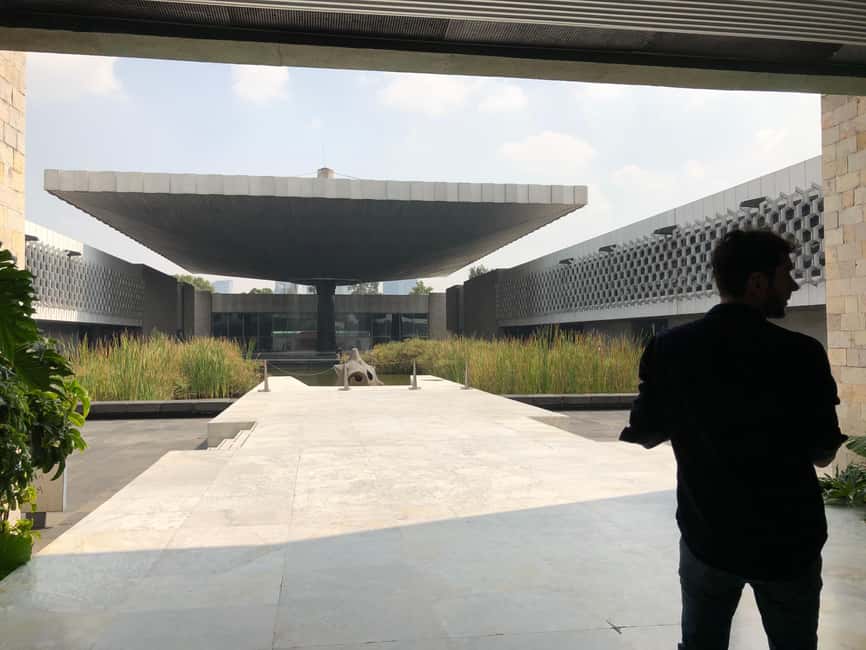
Before heading into the collections, the guide introduces the building. This is a smart beginning. The museum was designed to honor the cultures inside it, and its architecture uses murals, symbols, open space, and monumental forms to create a setting that feels connected to Mesoamerican ideas.
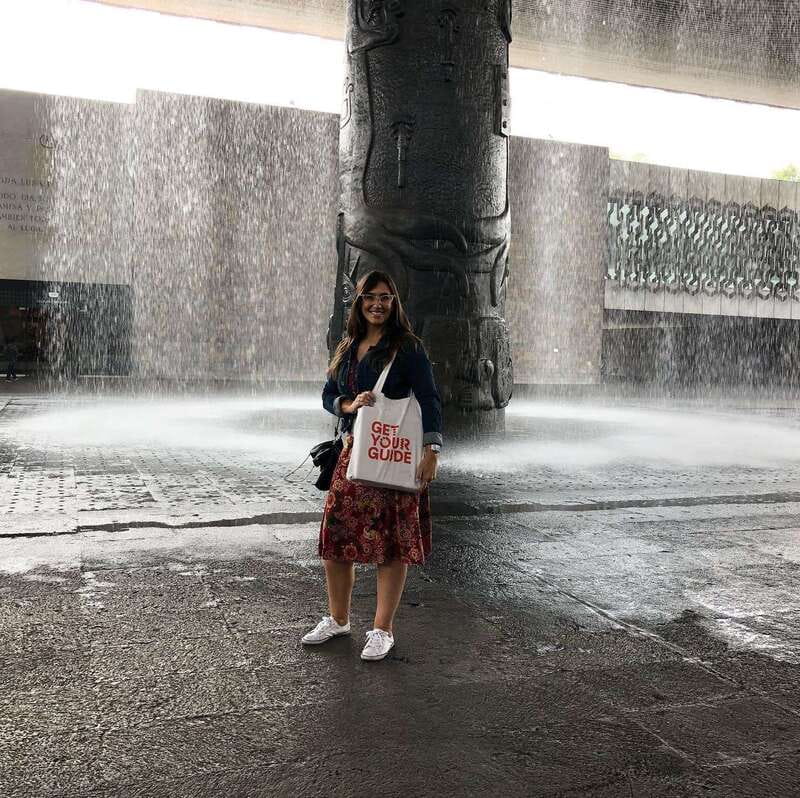
The courtyard fountain is one of the first major sights. Its broad canopy and falling water are difficult to miss, but the useful part is learning why it was designed this way. The fountain is not just a decorative photo stop. It helps explain how modern Mexican artists and architects interpreted pre-Hispanic forms while creating a national museum in the twentieth century.
This opening also gives you a chance to get oriented. The building is large, and the courtyard helps you understand how the rooms are arranged. I would pay attention here, because the architecture becomes part of the tour rather than something you rush past on the way to the artifacts.
What Mesoamerica means, and why the term matters
One of the most useful early lessons concerns the word Mesoamerica. The term was defined by scholar Paul Kirchhoff to describe a broad cultural region, not a single empire or nation.
That distinction matters. Mesoamerica included many peoples with different languages, political systems, and local customs. They were not one unified civilization. Yet they shared important practices and ideas, including forms of agriculture, trade, religious thought, calendars, artistic conventions, and social organization.
Your guide uses this section to set up the rest of the visit. Once you understand Mesoamerica as a connected cultural zone, the museum’s galleries begin to speak to one another. Similar symbols may appear in different places. Materials and techniques may travel. A later society may adapt an older visual form for its own political or religious needs.
This is where an academic guide earns the fee. A label might identify an object and give it a date. The guide can explain why it matters, what older traditions it draws on, and how historians know what they think they know.
Textiles, agave, and the practical side of ancient life
The textiles section brings the subject down to earth. You will see looms, garments, and woven materials from across Mesoamerica, while the guide explains spinning, weaving, and dyeing with organic pigments.
Textiles are easy to overlook in a museum filled with giant stone sculpture. I think that is a mistake. Clothing and fabric reveal labor, status, climate, trade, ritual, and technical skill. They also remind you that ancient societies were not defined only by temples and rulers.
Agave receives special attention. The plant supplied fibers, tools, household goods, and other practical materials. Learning about these uses gives you a more complete picture of daily life. Agave was not simply a drink ingredient or a modern Mexican symbol. It was a useful resource woven into ordinary work.
Natural pigments add another layer. The guide explains how color was produced from organic materials and applied to textiles or other objects. This helps correct a common museum illusion: ancient sculpture and architecture often look plain today because time has removed their paint.
If your interest is mainly monumental archaeology, this section may feel quieter than the Sun Stone or the colossal head. Still, it is valuable because it shows how technology and culture affected people outside royal or religious settings.
A few more Mexico City runs worth comparing
- Teotihuacan, Guadalupe Shrine & Tlatelolco Day Tour with Lunch
★ 5.0 · 11,603 reviews - Xochimilco, Coyoacan and Frida Kahlo with Optional Lunch
★ 4.5 · 7,320 reviews - Balloon flight + Breakfast in cave + Pyramids + Pick up CDMX.
★ 5.0 · 6,335 reviews - Teotihuacan pyramids morning or afternoon without tourist traps
★ 5.0 · 6,186 reviews
Ritual clothing and the long story of cultural exchange
The display of ceremonial clothing and ritual objects shifts the focus from household work to public identity. Here, the guide discusses festivals, body decoration, religious practice, and the ways communities express who they are.
This is also where the idea of cultural blending becomes more visible. Mesoamerican societies borrowed, adapted, and reworked traditions over many centuries. A visual motif might change meaning in a new setting. A garment style might signal rank in one community and ritual role in another.
The point is not to blur all cultures together. A good explanation should show both connection and difference. You will learn how shared traditions developed while still keeping each society distinct.
I find this part especially useful for first-time visitors because it moves beyond the simple timeline of first this civilization, then that one. The region’s history was not a neat relay race. Peoples traded, fought, migrated, borrowed, and created new identities from older materials.
The Olmec colossal head and the problem of labels
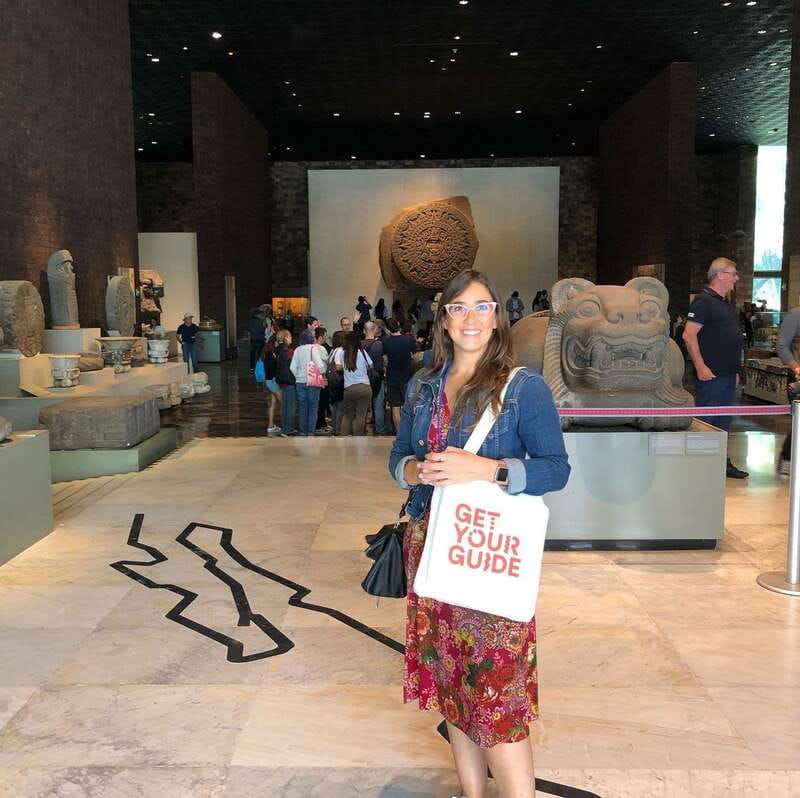
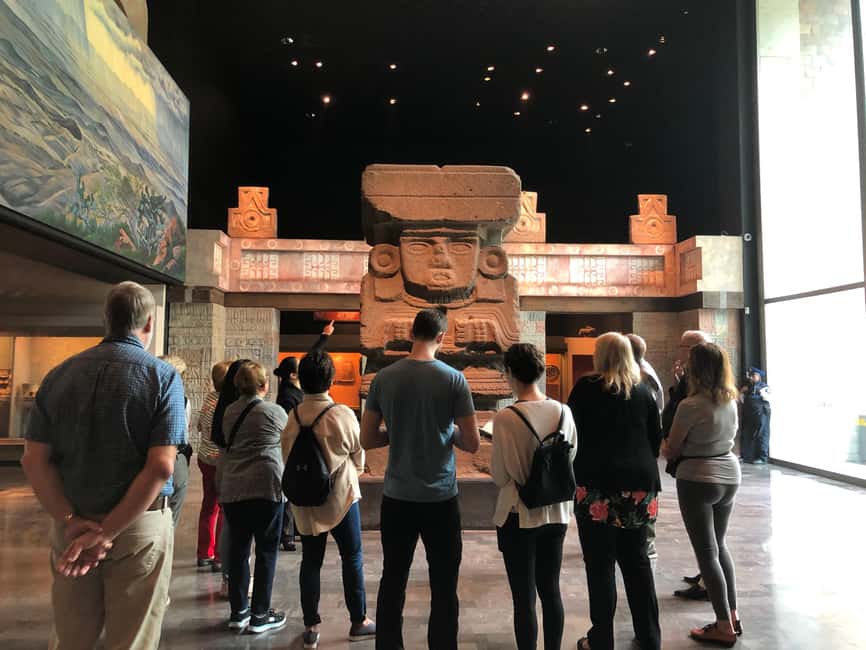
The Olmec gallery provides one of the tour’s first major visual stops. The colossal head is a powerful object even before you know anything about it. Its scale, expression, and stonework demand attention.
The Olmec are often described as a foundational or mother culture of Mesoamerica. That phrase can be useful, but it needs care. It does not mean every later civilization simply copied the Olmec. Rather, Olmec artistic forms and religious ideas appear to have influenced later traditions across a wide area.
Your guide explains what makes the head important and how scholars interpret its style. The discussion can include artistic influence, political power, and the challenge of understanding a society through surviving objects rather than written records.
This is a good example of why you should not hurry through famous pieces. You can take a quick photograph of the head in seconds. Understanding what its size, facial features, and stone transport may have meant takes longer.
The Mexica galleries: the Sun Stone, Templo Mayor, and chinampas
The Mexica section contains the objects most people already expect to see, including the famous Sun Stone. It is often called the Aztec Calendar, but that nickname is misleading. The stone is not simply a calendar hanging on the wall. Its imagery relates to Mexica ideas about time, creation, gods, sacrifice, and the structure of the universe.
The guide helps you read the symbols rather than treating the stone as a giant carved clock. This is one of the tour’s strongest themes: Mesoamerican art often communicates through layered imagery, and a single object can carry political, religious, and cosmic meaning at once.
The gallery also examines Templo Mayor and the Mexica capital. A detailed scale model shows how the city developed around waterways, bridges, aqueducts, and chinampas. Chinampas are often called artificial islands, but that short description does not capture the full hydraulic system behind them.
The model is particularly helpful because modern Mexico City has grown over the same area. Much of the ancient city lies beneath the colonial and modern capital. Looking at the model gives you a visual sense of how a water-based urban center functioned before the city was reshaped.
This section may be the busiest part of the museum, both in importance and foot traffic. The guide’s headset and clear voice matter here. If you hope for long, quiet stretches with each object, a group tour may feel brisk. If you want the main ideas and the chance to ask questions, the pace should work well.
Teotihuacán as a city of many peoples
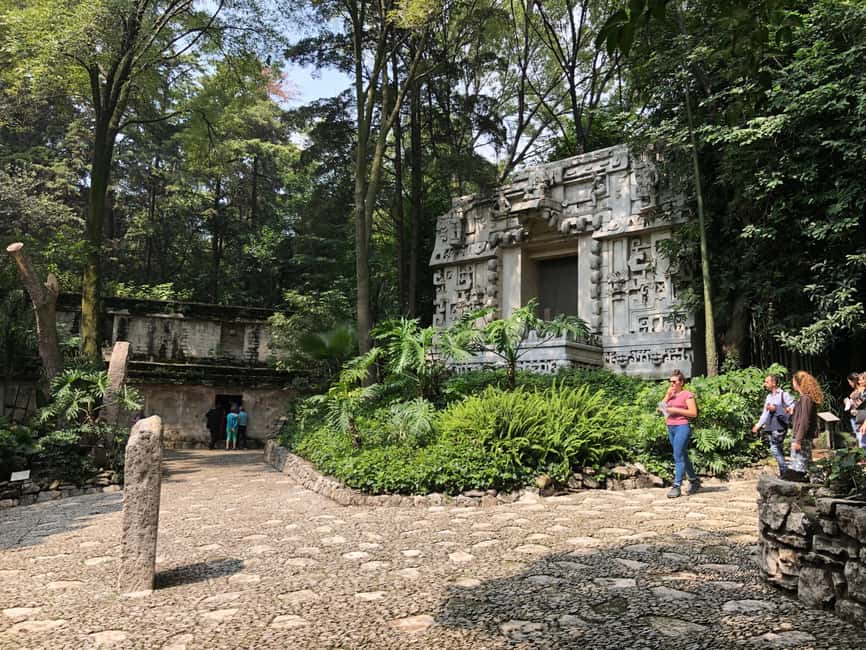
The Teotihuacán gallery corrects another common oversimplification. The city is often presented as if one clearly defined people created and controlled everything. The evidence suggests a more complex picture, with multiple cultural groups living in a large and influential metropolis.
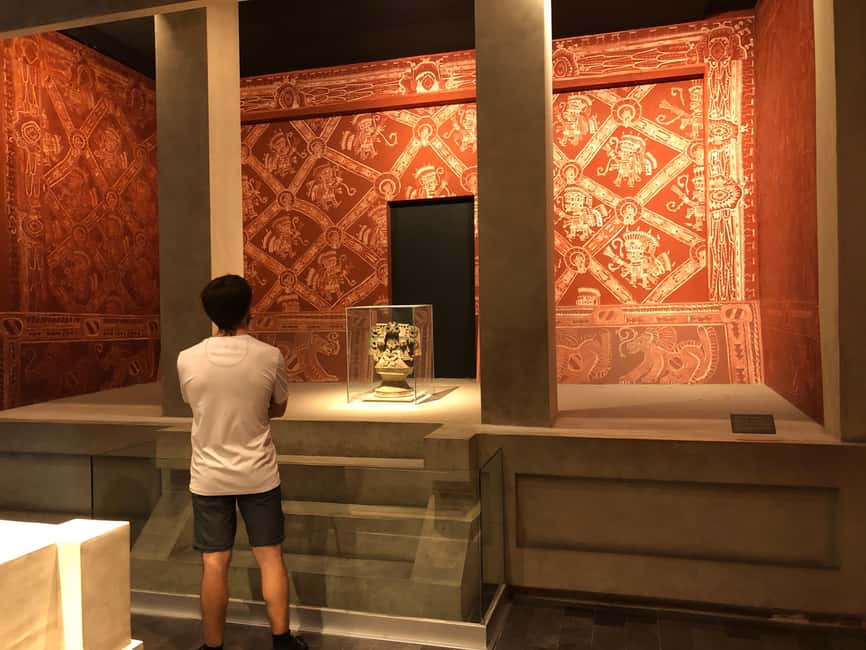
You will see refined ceramics, obsidian objects, mural fragments, and colorful architectural replicas. These displays help you picture Teotihuacán as a city with skilled craft production, long-distance exchange, religious authority, and different communities living together.
The guide also discusses theories about the city’s rise and decline. There is no single tidy answer to explain its transformation. That uncertainty is part of the appeal, but it can also frustrate visitors who prefer firm conclusions.
I like that the tour presents theories as theories. Archaeology depends on evidence, comparison, and interpretation. A good guide can tell you what is known, what is strongly supported, and what remains debated.
The Teotihuacán section also ties back to earlier themes. Obsidian shows the importance of natural materials and trade. Murals show how color and visual storytelling shaped public spaces. Ceramics reveal both everyday use and artistic skill.
Maya writing, portrait ceramics, and Pakal’s tomb
The final major section focuses on Maya art and writing. You will see ceramic portraits, painted vessels, and jade carvings, all of which help show the range of Maya craftsmanship.
The story of decipherment is one of the most memorable parts of the tour. Understanding Maya writing required colonial records, lost or damaged manuscripts, comparisons between known languages and ancient signs, and the work of scholars from different backgrounds. One especially unusual figure in this story is a Russian soldier from the Second World War whose ideas helped move the field forward.
This is a good place to ask questions. Maya writing is not simply a collection of decorative symbols. It records names, events, political claims, religious ideas, and the actions of rulers. Once you understand that, painted vessels and carved monuments become more like historical documents.
The tour ends at the replica of Pakal’s tomb, one of the museum’s most dramatic spaces. The recreation gives you a sense of the chamber and the objects associated with the Maya ruler without requiring a visit to the original tomb.
The guide also tells the strange story of the museum theft on Christmas Eve in 1985, when Pakal’s mask and other treasures were stolen. It is an odd but fitting final story: the museum is not only a place for ancient objects, but also a modern institution with its own difficult past.
How much value do you get for $175?
At $175 per person, this is not a bargain admission ticket. The museum ticket is included, but food, drinks, transportation, and hotel pickup are not. You meet at the museum, so budget separately for getting there and for any meal afterward.
The value comes from the guide. If you already have a strong background in Mesoamerican archaeology and enjoy reading labels at your own speed, you may prefer independent entry. You can visit the highlights yourself and return to the galleries that interest you most.
For most first-time visitors, though, the museum’s size makes expert help useful. You get a planned route, historical context, and the chance to ask follow-up questions. Some tours finish close to three hours, while one reported experience ran about four and a half hours. Do not schedule an important appointment immediately afterward.
The group limit of 10 is another reason the price can make sense. This is not a large coach group moving from object to object. You should have a better chance of hearing the guide and asking questions, though the exact feel will depend on how many people book your time.
Who should book this museum tour?
I would choose this tour if you want Mexico City’s ancient cultures explained as a connected story. It suits history fans, art lovers, and anyone who feels intimidated by a huge museum. It also works for families with older children, since Natalia has been praised for keeping both children and adults involved.
You do not need previous knowledge. The tour begins with definitions and basic context, then builds toward more complex subjects such as writing, cultural exchange, and archaeological interpretation.
You may want to skip it if you prefer wandering alone, need a slow pace, or want to cover every gallery. Three hours is a highlights tour, not an exhaustive examination of the museum.
An adult must accompany children. The tour is wheelchair accessible, and English and Spanish are offered. Cancellation is free up to 24 hours before the start, and you can reserve now and pay later, which helps if your Mexico City schedule is still changing.
Should you book it?
Book this experience if you want the Anthropology Museum to make sense, not just look impressive. Natalia and Hector bring the strongest asset: clear teaching backed by art history and historical training. The tour’s best moments are the connections, from agave and pigments to Mexica water engineering, Teotihuacán’s mixed population, and Maya writing.
The price is high, but the museum is large and the material is demanding. I would especially recommend it for a first visit, then stay afterward to revisit the objects that caught your attention. If you want a quiet, self-directed museum day, buy your own ticket instead. If you want the stories behind the stone, jade, fabric, and painted clay, this is money well spent.
FAQ
How long is the Mexico City Anthropology Museum tour?
The scheduled duration is three hours. Some visits may run longer, so avoid booking another fixed activity immediately afterward.
What is included in the price?
The price includes the museum ticket, an expert guide with a graduate academic degree in art history or history, and headsets for large groups.
Is transportation included?
No. Transportation, hotel pickup, hotel drop-off, food, and drinks are not included. You meet your guide at the museum.
Where do I meet the guide?
Meet in the museum’s main lobby near the ticket booth. Your guide will be waiting with the Walk Mexico project logo.
Which languages are available?
The tour is offered in English and Spanish.
How large is the group?
The tour is limited to 10 participants. Headsets are available for large groups so you can hear the guide more clearly.
Is the tour wheelchair accessible?
Yes, the activity is wheelchair accessible. An adult must always accompany children.
Newly listed around Mexico City
- Ticket to Frida Kahlo Museum on CDMX★ 4.5 · 44 reviews
- Epic Centro Histórico Walking Tour★ 5.0 · 77 reviews
- Eat and Explore Local Markets in Mexico City★ 5.0 · 83 reviews
- Eat Like A Local By The Taco Mensch★ 5.0 · 55 reviews
- Ticket for the Frida Kahlo Museum★ 3.5 · 67 reviews
- Authentic Lucha Libre Tour : Wrestling School, Tacos & Mezcal★ 5.0 · 162 reviews
- Express Tour to Teotihuacan Pyramids. Be the first to arrive!★ 4.5 · 62 reviews
- Small Group: The Magical Colonial Towns of Taxco and Cuernavaca★ 4.5 · 46 reviews
Museums, compared.
Xochimilco, Coyoacan, Frida Kahlo Museum & Murals Tour
Read our review →
Chapultepec Castle & Anthropology Museum Tour
Read our review →![Frida Kahlo VIP [Museum Tickets Included] Bike, Markets & Churros](https://d1.introducingmexico.com/wp-content/uploads/frida-kahlo-vip-museum-tickets-included-bike-markets-churros-400x267.jpg)
Frida Kahlo VIP [Museum Tickets Included] Bike, Markets & Churros
Read our review →
![Frida Kahlo VIP [Museum Tickets Included] Walk, Markets & Churros](https://d1.introducingmexico.com/wp-content/uploads/frida-kahlo-vip-museum-tickets-included-walk-markets-churros-400x267.jpg)
Frida Kahlo VIP [Museum Tickets Included] Walk, Markets & Churros
Read our review →
EXCLUSIVE TOUR Frida Kahlo Museum – SMALL GROUPS
Read our review →
Coba Multun-Ha Cenote Tulum and Mayan Museum Small Group
Read our review →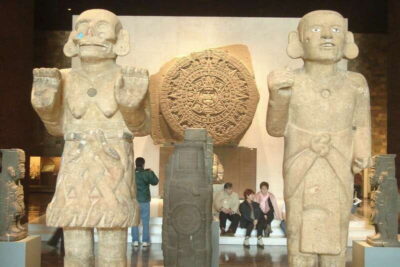
Browse the lists this tour appears in